Showing posts with label 1L. Show all posts

August 4, 2019

OCI: On-Campus Interviewing for a Summer Associate Position at a Biglaw Firm

Tips and advice for law school on-campus interviews. 1L OCI help. How to prepare for law school OCI. What happens during law school OCI. What to wear to OCI interviews. How to follow up after a law school OCI interview. How to be impressive at a Big Law OCI interview. How to go into Big Law after law school. 2L OCI advice. How to prepare for an OCI call back. OCI Lunch. OCI for Big Law | brazenandbrunette.com

Hey everyone! I'm excited to share with you another guest post from The Unbillable Life! I am so happy that she has agreed to share how she figured out the confusing OCI process and was able to go into Big Law. If you're an upcoming 2L looking for OCI advice or a 3L considering accepting a Big Law job, she has literally answered all of your questions an more. A little bit more about today's guest post...


The Unbillable Life is a career blog written by a former Biglaw associate attorney who writes about her experiences at a high-paying and high-stress law firm job in NYC.  Along with advice on how junior attorneys can succeed in Biglaw, she also blogs about why she left that career after 8 years to pursue an alternative, less traditional path.  During her time in Biglaw, she was active in summer associate recruiting and is excited to share her inside advice on OCI here. Read more career success tips and career change advice on the blog, The Unbillable Life, or send an email to theunbillablelife@gmail.com with any questions or comments.


Interviewing for a Biglaw Job, aka “OCI” 


“Biglaw” is the nickname given to large law firms with offices in cities all across the U.S. and around the world.  With very few exceptions, all Biglaw firms recruit law students the same exact way: through an interview process called “on-campus interviews” or “OCI” (or a variation on that name, depending on your school).   


As a law student, your first exposure to the world of Biglaw will likely come through the OCI process.  Even if you had a career before law school or held a job during college, interviewing for a Biglaw job is a whole new ballgame and an entirely distinct process from any other interviews you will ever have.


When Is OCI?


OCI begins in late July or early August after your 1L year and lasts for a few weeks.  (Each school is slightly different in their approach for how students sign-up for interviews, so career services at your school is the best place to look to for all of those process-specific details; we won’t get into them here.)


You read that correctly – after just one year of law school and one summer internship, it is already time to apply for summer associate positions.  


You will be interviewing for the job you will have the next summer – the one after your 2L year.  And if all things go well during that 2L summer (i.e., you liked the firm and the firm feels the same way about you), that firm will be the one you begin your career as an attorney at after you graduate from law school.  


I say all of this not to make you feel extra-anxious, but rather to illustrate the point that OCI is very important for any law student looking to work in Biglaw.  While there are other ways to get your foot in the door of Biglaw, by far the easiest and most traditional way is to secure a Biglaw summer associate position through OCI.  


To help guide you along in this process, this post covers: screening interviews, callback interviews (how to prepare for them and how to ace them) and post-interview best practices.  


Ready to dive in and land that Biglaw summer associate job?  Here we go! 


What Year Law Students Participate in OCI? 


As noted above, the vast majority of students interviewing for summer associate positions are rising 2Ls.  


Depending on the firm, there are sometimes positions open during OCI for rising 3Ls, but these spots are generally very limited.  A firm might be looking for a very specific candidate (someone interested in their arbitration group, for example) or perhaps they miscalculated the number of summer associates in their class the summer before and are looking to supplement the incoming class with a few more associates, in which case they might interview a few rising 3Ls. 


For all of the eager, rising 1Ls out there, some law firms have a select few spots reserved for very promising 1Ls.  If, during your fall semester of 1L year, you think you would be interested in a Biglaw summer associate position after your 1L year, reach out to career services at your school to see how this process works.  You would have to apply in the winter (sometime after first semester 1L grades are released) in order to get a Biglaw job your summer after 1L year.    


Every law firm will make it clear in the screening interview portion of OCI whether they are accepting 3L or 1L applicants or if they are only interviewing 2Ls.   


Before the Interviews Begin – Let’s Get This Out of the Way: What Should You Wear?


Career services offices and law students often spend way too much time focused on and fretting over appearance for interviews.  As long as you are wearing a suit (both men and women – and for women, that can be a skirt suit or a pantsuit, whatever you feel more comfortable in), you will be fine.  


Aside from making sure the candidate meets this basic level of professionalism, nobody will spend any time thinking about or judging your appearance.  


Not once did I come across a candidate where his or her wardrobe distracted me or took away from the interview, and I never discussed or heard any of my colleagues discussing a candidate’s outfit or appearance.  


Which means, law students are doing something right out there, so do not stress about your appearance!  There are more important things to get right in the interview than the perfect blouse. Now that that’s out of the way, let’s move on to the more substantive and important aspects of OCI.


Screening Interviews 


The OCI screening interview is the first step in the Biglaw summer associate job search process.  You will (hopefully) be assigned many screening interviews that take place at your school (hence the name “on-campus”) or at a nearby hotel.  


While it sounds weird to have a job interview at a hotel (and it is), because schools don’t have room for all of the interviews that take place during the few jam-packed days of OCI, they rent out nearby hotels where interviews are conducted in actual hotel rooms.  Law firms set up shop in a room for the day and students are shuttled in and out for their screening interviews all day long.   


The screening interview is a preliminary 20 to 30 minute interview where the interviewer (a partner, counsel or senior associate at the firm) assesses whether you fit the firm’s basic, minimum requirements and whether they see you as a potential, future colleague.  


Because the screening interview is so short, the interviewer is mostly looking to see whether your GPA is high enough to meet the firm’s standards and whether there was something about you that impressed him or her enough that he or she wants to call you back to meet more attorneys at the firm.  


The interviewer is screening you to see whether or not to offer you a “callback interview,” which is when you go to the firm itself (if you are in another city, you will be flown in to the interviews, on the firm’s dime) for a series of interviews with more attorneys.  


If all goes well, your screening interviewer will give you a phone call the evening of your interview (or the day after) to let you know they enjoyed meeting you and that the firm would like to have you back for further interviews.  


If they leave you a voicemail, make sure to call them back (or, more likely, the recruiting department) to accept the callback and begin to make arrangements for it.  If you don’t receive a call, it means you didn’t get a callback from that firm, but don’t be discouraged as there often just aren’t enough spots for all of the qualified candidates.  


Now that you’ve secured a few callback interviews, let’s discuss in depth what the callbacks entail.   


The Callback: A Series of Interviews at the Firm


A callback interview day consists of four 30-minutes interviews with a mix of partners and associates from various groups across the firm.  The morning of interviews is usually capped off by a lunch with a couple more associates and a few other interviewees. Let’s dive in to your callback day because this is when the most important part of OCI takes place.  


How to Prepare for Your Callback


Here are a few key things you can do to prepare for your callback interviews (quick note: these tips also apply to preparation for your screening interviews, although you won’t be expected to know anything about your screening interviewers ahead of time):


1. Know your resume really well.


Know your resume like the back of your hand and be prepared to answer questions about any aspect of it.  If, for example, you choose to highlight your senior thesis from college on your resume, you better remember what the thesis was about and have a brief summary of it prepared because you’ll definitely be asked about it at some point during the process. 


For great tips on preparing a resume that will help land you the job, check out this post.


2. Be prepared to answer the question, “so, why do you want to work at Firm X, Y and Z?”


Your interviewer is going to want to know whether you have an interest in their firm or if you are just trying to get any Biglaw job you can.  While it might seem like all Biglaw firms are alike, I can tell you that most Biglaw attorneys think their firm is “different” (in a good way) from the others.  Try to figure out what sets the firm apart from its competition and prepare an answer based on that.  


Your answer should suggest that you’ve done a little bit of research and have a real reason for wanting to be at that particular firm.  It doesn’t have to be super detailed as to why, but it does have to be applicable (for example, if you speak Portuguese and answer that you are interested in working with clients based in Brazil, but the firm doesn’t have any offices in Brazil, that might not be the best answer. But it would be a great answer if the firm does have offices in Brazil!). 


3.  Know a little bit about your interviewers.


Before the interview, you are going to be told the names of the interviewers.  Do a quick search of their bios on the firm site, but don’t dig too deeply – you are not expected to have memorized their recent deals.  Get an understanding of their basic field and be prepared to ask a few questions about it.


Note that it is not necessary to know anything about the screening interviewer, as you probably won’t know ahead of time who they are.  Even during a callback, sometimes you are given the names of the interviewers, but they change at the last minute (usually because a work conflict arose).  If you end up with a last minute change, don’t stress out about this at all, as there is no way you would be expected to know anything about the new interviewer.  


4. Prepare some questions.  


At the end of the interview, or if there is a slow spot during it, most interviewers will ask a candidate if he or she has any questions for them.  


You cannot answer “no” to this!  


If you say no, that indicates that you’re not really interested in the job.  Instead, come prepared with a couple of pointed questions about the firm, firm life, what it’s like to be an associate, etc.


It’s best to ask relevant questions you actually want to know the answer to.  For example, if you are a woman and are interested in the women’s network, ask the female associate about it.  If you ask someone you thought would be prepared to answer the question, but they don’t seem to know much, ask if they could give you the contact name of someone who would be better suited to discuss that with you (if it is something you really want to know).

During the Interviews


Your goal for each of your four interviews is to show the attorney that you have both the intelligence to do great legal work and the personality to “fit” in at the firm, both with the other attorneys and their clients.  


How do you show this?  Well, this is the million dollar question and unfortunately almost impossible to answer!  


Because every attorney looks for something different in a candidate, the only way to really prepare is to follow the advice above, put it into practice during the interview and hope that you click enough with each interviewer that they give you an offer.  


It is impossible to say exactly what will land you the job, but a relaxed yet still eager and enthusiastic candidate was usually the one who made my list.  Other qualities that people look for include: your level of maturity (can I picture you interacting with the firm’s clients?) and whether or not you are a team-player (can I imagine relying on you when needed and coming through for the team during a stressful situation)? 


After the Interviews: Lunch 


The post-interview lunch is meant to be a place for the interviewees to get to know a few more associates and to freely ask questions.  


At my firm, unless someone did something crazy at lunch (which I never heard of someone doing) the lunches really, truly were for the benefit of the interviewees.  The associates who went to the lunches didn’t even have to formally report back to the recruiting department about how the lunch went. 


So try to relax (really try to relax the whole day, but especially at lunch!), enjoy the food and the company and try to get a sense of whether you could see yourself working at that firm and with those people. 


Post-Callback: What to Do


At the end of the day, send a quick thank-you email to your interviewers.  This is not a requirement or a make-it-or-break-it tip, but it is the polite thing to do.  It’s not going to totally change someone’s mind about you, but if they are on the fence about you, it doesn’t hurt to give them one more positive impression of you.


What should you say in the email?  A simple “thank you for your time” is enough, but it’s even better if you can refer back to something you discussed.  For example, you could note that you enjoyed learning about the deal they were working on or send them the link to your favorite Mexican restaurant that you recommended during the interview. 


That’s It!


Other than all of that (which I know is a lot to take in!), there’s not much to do but wait to hear if you get the offer!  It can take firms a while to get back to you with an offer (or a rejection), so don’t be discouraged if you don’t hear back that evening or even the next day or two.  


Even if everyone at the firm loved you, there are some behind-the-scene things that go into making candidates an offer that don’t necessarily have much to do with how much you were liked or how great of a candidate you are.  


For example, your offer might hinge on how many outstanding offers the firm has made and are waiting to hear back on.  Each firm can only accommodate so many summer associates, so it is a numbers game. Often firms will have to wait for one student to reject their offer before they can offer the position to the next student.  Be patient and know that your offer might even come a few weeks after your callback took place.     


Last but not least, good luck to all of the 2Ls going through OCI over the next couple of weeks!  It can be a tiring process, but is so worth it if you want to start your career in Biglaw. When you do land that summer job, before you start next summer, be sure to check out my top tips on how to be the best summer associate

And remember that you can reach out to The Unbillable Life at theunbillabelife@gmail.com with any OCI or other law firm-related questions, comments or suggestions for future blog topics to tackle!

November 5, 2018

Visiting Law School Professors Office Hours

How to prepare for visiting your law school professor's office how's, why you should visit your law professor's office hours, what to do when visiting your professor's office hours after your law school midterms, why you should visit office hours to prepare for your law school finals, what to do at law school office hours, and how visiting office hours can help you in law school. law school exam help. law school studying tips. law school finals advice. law school blog. law student blogger | brazenandbrunette.com

Well, well, well. If it isn't finals, sneaking up right after you thought you were safe from midterms. Sucks, right? Yeah, in case you haven't noticed, "this sucks" is a general theme of law school and like you've probably noticed, it won't get easier from here but you're just going to get used to it now. If you're stressing about the idea of finals looming in, take this moment to take a breath and calm down but then resist the urge to run away from your responsibilities and finish this post. For my sake at least so I don't feel like a loser who makes blog posts that no one reads lol :) 

Anyways, let's talk about midterms real quick (and not the elections haha). Let me first acknowledge that most of you did worse than you were expecting. That's okay! It's rare to do well on your first law school test, and it's even rarer that anyone actually thought they did well and also happened to do well on it. It's just part of the fun, self-esteeming boosting method of law school 🙃 

So, when I was a 1L the ABA was just starting to recommend midterms because as you might've heard in the news, law school performances are all over the place and the ABA thought it might be nice for schools to realize that all of their students are struggling hard core before they're one final grade. I know midterms suck, but be grateful for them!!! Yeah you probably did bad. Remember how I failed one of mine? It's better to find out you were failing before the big test than in January when you find out you're on academic probation! This is a scrimmage game to help you see where you're killing it and where to improve. How do you know these things? Well, my friend, please refer to the title of this post!

Related: The time I almost dropped out of law school


Call ahead

Not literally, but do give your professor a heads up. It's not a great plan to just show up willy nilly at office hours expecting to get anything out of it. First off, there's a whole class full of people with the same intentions as you. You're not going to get to talk with your professors about their personal suggestions on how you could be an A student if there's 10 other people in their office trying to do the same. Second off, professors have a life and job outside of office hours so you don't want to be rushed trying to review the answer key before your professor kicks you out because he has another class in 10 minutes.

This is a very critical step in beating law school, so don't rush through this. Email your prof ahead of time and schedule a time to meet with them. You're an important ray of sunshine and you deserve a full hour (or however much they schedule it for) and deserve their full, undivided attention. I know that some professors will just be like just stop on by during office hours and if that's the case then fine, but don't just assume that and at least first try to get the solo VIP treatment that you deserve.


No matter the grade, GO

Luckily for the purposes of this blog, I've been through it all— from surprising myself with better-than-expected grades to embarrassing myself with WTFFFFF went wrong grades. Even if you got an A+ you still need to hop off your high horse and go see the professor about your test. Why? Because they is always room for improvement in the legal field. That's why it's called practicing law. Be a learner, not a knower! Trust me, even the top scorer from a T14 school has tons of room for improvement because you are far from being a qualified attorney. 

On the flip side, yep it's embarrassing as hell to participate in class and put forth all your effort and get a disappointing grade. Lick your wounds because I know it hurts. But, my dear, that is the way of the law. Every single person in this profession has thought they killed a cold call, exam, motion, trial, and ended up looking like an idiot. Anyone who says otherwise is a damn liar. So have a little comfort knowing you're not the only one who has messed up and take it from me that you can turn this semester around. Your mission (that you have no option of "should you choose to accept" because it's your future on the line, nbd) is to figure out your strengths to keep those up for next time, and figure out your weaknesses to strengthen up for next time.


Approach it with a game plan

Don't just come in and expect your professor to do all the work. Remember, this is law school so the hand holding pretty much ended at orientation. Take a notebook with you and find out these answers while you're there:

Essays
What was a model answer? Either from last year's final or a sample of one of your classmates of what they like to see.
Where was I the weakest at? Most 1Ls have a problem of stating a conclusion without backing it up (using "because" in their analysis). But some have a problem of missing the issue completely so their whole response is off. Some have problems articulating their arguments. And sometimes you just flat out didn't know the rule. 
What is one of my strengths? Find out the best one or two things you did on that paper, and learn how to improve them. This can help you go from getting 2 points on the conclusion to 3 points and all these 1 extra points can help you when it comes to the curve. Remember, no matter how great you are there's still room for improvement!

Multiple Choice
What areas of the law am I missing the most? (example, for Torts I somehow forgot that intentional torts existed and answered all of my questions based off negligence)
What type of questions am I missing the most? (do you know the rule but are missing the issue, spotting the issue but missing the rule, getting confused in the facts, missing double negatives in answers)
Are there any old tests I can review? What supplements do you recommend?
Why am I missing these questions? This is more for you to consider because a professor probably won't know. (were you rushing through it and will need to work on timing, are you misapplying rules because you don't know them well, are there similar rules that you're getting confused) 

Related: How to prepare for different law school test questions

Shoot your shot

This will not work for most professors, but like the heading says, shoot your shot. Come in with your outline (or schedule this later for time concerns) and ask your professor to look over it. Are you being too broad with the concepts and missing points by leaving out the details? Are you too hyper-focused on minute details that you're slowing yourself down? Don't ask them to edit your outline for you, but just ask if they think you're adequately studying the material.


This can actually be a major help for you if your professor is willing to do this. If you're zoomed too much out or in and they can help you with this, then you can improve your studying for the final. If your professor isn't up for this, try to have them steer you in the right direction for help, like to a tutor. And if you don't get this, still reach out to an upperclassmen who did reasonably well in this class with this professor and knows what they're looking for. Making your own outline is super helpful when studying, but also nerve-wrecking because you never know if you're doing enough or too much, and this is how you find out that answer. Remember, you never get what you don't ask for! 

Be professional nice

Hi do I sound like your mom yet? But for real, take this piece of advice seriously. I've felt and seen everything from walking in all hot because you just aced the test to wanting to cry because you're sucking it up to wanted to yell because you just can't believe you did that poorly. Resist all these urges. Go out with your classmates for drinks and get your emotions out before you even email your professor about your test.

This person in front of you has a lot of power, but it's easy to forget that. If you want a job next summer or a scholarship next semester, the person you're going to right now might be just the person to help you out through a little thing called a rec letter. And if you show up prepared and work with them on improving yourself, then maybe you'll be in a prime position to take them semester after semester and go from getting a B to a B+ to an A- and wow hello good GPA. Beyond that, remember that your professors are still remembers of the legal community and likely have a million lawyer friends (because no one else will put up with our lame law jokes) and can recommend you for a job or hook you up with a mentor later on. Basically, just remember to be strategic with your moves in law school because you're building up your reputation and career opportunities right meow.


Look, I know that visiting professor's office hours seems like one of those things that everyone says to do but you don't actually do it... but DO IT!! It's one of those things that feels like it'll be really awkward and embarrassing at first but then once you do it, you're sooo glad you did! Oh and once you go, make it a personal mission to go again at least once more and no later than 2 weeks before the final.

What's the most helpful question you've asked (or wish you would've asked) during office hours? And how often do you actually go to office hours? Let me and all your fellow law students know in the comments! 


let's be friends!


September 12, 2018

Why You Should Make Friends in Law School

Why you should make friends in law school. The benefits of friends in law school. How to make friends in law school. Why it's important to make friends in law school. Making friends your 1L year. Socializing in law school. How to make law school fun. Should you be friends with your law school classmates? law school tips. law school advice. law school blog. law student blogger | brazenandbrunette.com

Happy humpday everyone! Today I wanted to talk about a message for all the baby 1L's out there: don't try to go at law school alone. 

When I first started law school I didn't put too much emphasis on finding friends. I mean, I already had my high school friends plus my college friends so really how many more people did I need in my life? But the reality is that law school friends are totally different than non-law friends. The truth is, your non-law friends just won't get it. Even the pre-law friends can only empathize so much because they haven't actually gone through the rigors that is law school. Your law school friends will totally understand what you're complaining about, can help explain a concept that you're not understanding, and can give you peace of mind when they tell you that they also haven't got a call back about that journal/team/job yet so you're not alone. 

A big misconception about law school is that it's every man for himself. People will wrongly think, oh if I give my neighbor my notes from yesterday, then I'm helping her get ahead of me and am screwing myself over. This can't be more wrong! Look, the girl next to you is either going to get a better grade than you or not all on her own. You helping her out one day isn't going to make or break you. 

Remember, basically your entire grade comes down to the final. Do you really think helping out a classmate here and there is somehow going to make their answers on their final that much better than yours? If y'all really were that close on the curve, then there's a very big chance that because of the curve you're going to both end up with the exact same grade. So why bother wasting your time being rude? 

Related: Putting the law school curve into perspective

Storytime from my 1L year... we had a research assignment for my writing class so my entire small writing section were all in the library at once, doing the same assignment at once. Since everyone was waiting to use the same books I decided to just work from the last question up so I wouldn't be there all night. About halfway through I was again working on the same questions as the rest of my classmates. So when one of my classmates asked me where to find an answer, I gave them the book I had just used. A few minutes later I asked the same person if they knew what one of the questions was asking about, and they told me that I should just work on the assignment myself! Guess what happened? I had some strong feelings about that person and one day when I happened to be sitting beside them and they were having trouble with a case, I opted not to help even though I could.

The moral of all this? You're not invincible and you'll learn that you're going to need help in law school at some point. Don't think of it as you against everyone, think of it as y'all against law school. These people are your teammates and can help you in countless ways throughout law school. And beyond! You'll hear so many lawyers talking about how they've gone out of their way to help an old law school friend get a job, but also some people are in the position I was in during class and can help you but choose not to because you've burned them before. 

I'm not saying you have to go and befriend the whole school, but do make an effort to be nice. And constantly seek out people to add to your little study group. These are the times where truly, the more the merrier! This isn't like Survivor or The Bachelor where there can only be one person at the end. Sure, there's only one valedictorian, but there's plenty of people in the top 10, 20, 50%. If you try to cut everyone down you're going to be extremely lonely and I promise you're just making law school harder than it has to be. 

Related: How to find a law school study group

As far as cliques go, try to rise above them. One of the things that shocks 1Ls the most is how law school feels like high school all over again. I've seen several cliques who basically have Mean Girls-level rules in law school and it's ridiculous! Don't get too tied down and insist on it being you few til death do you part. These kinds of cliques can be just as isolating and therefore counterproductive as if you cut out everyone else from your life yourself. Try to keep some fluidity in your friend group and it'll help y'all survive all 3 years. 

I know I sound just like my mom right now, but go in with an open mind! A lot of people have totally different in-class and out-of-class personas so just because you wouldn't exactly want to sit by them every day right in the middle of the front row doesn't mean that y'all couldn't get along during breaks when you're venting about your days. 

August 13, 2018

Law School Questions and Answers

Questions about law school answered by a real law student. Advice on applying to law school, advice and tips for a 1L, advice and tips for a 2L, answers about the bar exam. law school blog. law student blogger | brazenandbrunette.com

Well, well, well. My first post-Bar blog! I'm not quite ready to blog about that until I get my results so instead today I'm sharing some answers to questions I got on Instagram over the weekend and elaborating a little more. Also, you might notice that the 0L/1L/2L/3L tabs at the top are a lot more user friendly so while I haven't been blogging lately, I have still been working on it for y'all! I didn't give much notice before doing the Insta Q&A so if you missed out on that, feel free to comment below or use the "questions and suggestions" box on the bottom right!


First of all, make sure you're making an informed decision on law school.


Second, once you know this is what you want, start studying for the LSAT. I suggest you do this in the summer so your GPA doesn't slip from you trying to multitask. And make an informed decision on whether you want to retake the LSAT.


Third, start the application process.


Fourth, decide on a school.


Fifth, prepare for law school.


My tip for using supplements is to remember that they're just that– supplements! If you eat an orange every day then you don't need to take a Vitamin C supplement and if you feel like you understand your classes then you don't need a supplement. Wait a few months to see how you're doing in classes before you spend money on a book that you probably won't even have time to read. That being said, I do believe that they can really help make sure you're prepared for finals.


I actually have several posts on time management that go more in-depth on these answers so I'm just going to link them all for y'all.

A breakdown of my schedule as a 1L and 2L 


Friendships in law school can be tricky because at times you'll need to prioritize getting readings done over hanging out or chatting with friends, but also it's really important that you don't let law school ruin all of your friendships. Make time for the things that are important to you in life!


As you just read, I actually didn't use a binder system so they're definitely not necessary, but my friend did and she found it really helped her for finals. I say go ahead and try it and then if it's not working for you then don't feel guilty abandoning it.


Oh the first day as a transfer student can be so weird! You have the confidence of a 2L because you've survived a year of law school already, but also have the insecurities of a 1L because you know nothing about your new school. I highly recommend seeking out a friendly face in your first class of your first day so you won't spend all day wandering around lost. And by the end of the first week or so maybe you'll have noticed the same person in a few of your classes and that's also a good person to befriend because they can be your study buddy. 

In fact, the girl that I sat by in my very first class at my new school also happened to sit by me at graduation because our last names were in alphabetical order so it was perfect that she'd by my side through the end.


I wish I would've started job hunting a lot earlier my 2L year. Because I transferred I waited until we got our grades back since I technically didn't have a GPA or transcript, which was so dumb and I could have just used my old school stats. In the end I did land a paying internship which was nice but I do wish I could've found an internship that gave me more opportunities to gain experience.

Related: The differences between 1L and 2L year and How to find legal internships 

However, one thing I don't regret is getting really involved in pro bono my 2L year. Not only did this make sure that I met my school's requirement to graduate, but I learned a lot helping with that and I'm so glad that I did.

Related: Where to find pro bono opportunities and How to squeeze pro bono time into a busy schedule


You spend your entire 1L year just trying to survive, but once you get to be a 2L I think your focus should be on building upon the previous year and always striving to be better.


Secondly, I do wish I had got the MPRE out of the way earlier since I had to study for that during November of my 3L year when I should've been using that time to study for finals.


I felt like my first semester of law school was like 2L year all over again but the last semester gets hectic fast. Graduation planning, Bar prep planning, and job hunting all kinda happen at once. I do wish I would've put more effort into job hunting because then I could be getting paid right now, which would be nice. 

Luckily, I didn't have any finals my last semester so I didn't go from taking a final on a Thursday, graduating that Saturday, and starting Bar prep the following Monday, but that's not an unusual order. Try to make your last semester easy classes and hopefully early finals so that you can get a little mental break before starting Bar prep.


These answers are short and I don't have a lot to say here because I want to wait until I get my results to do those posts. So although I don't want to write Bar posts, I do have a lot of posts planned and outlined out about all of these questions so those will be coming eventually. Check back here in November!


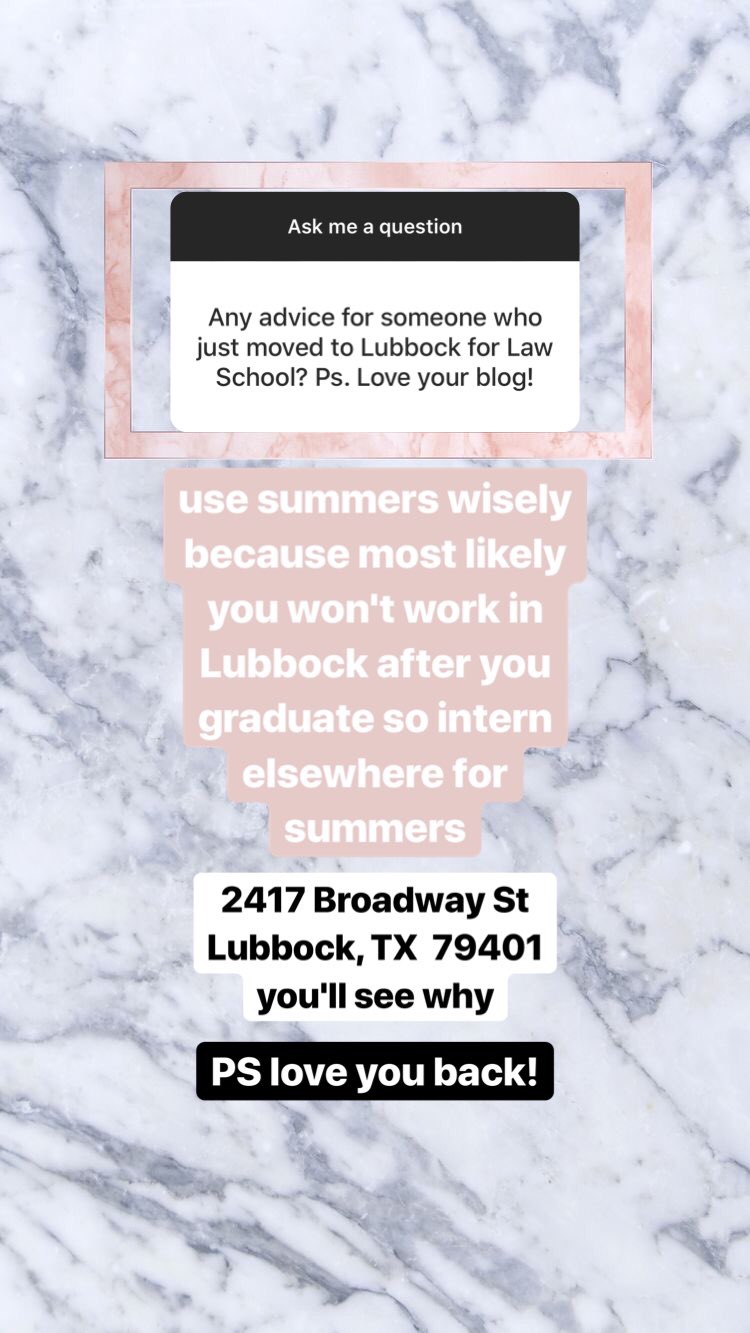
Since I did go to 2 different law schools, I'm planning on doing a guide for both San Antonio (St. Mary's) and Lubbock (Texas Tech) this semester. But for now, this will have to do since I'm sure most of you aren't going to those 2 schools.