Showing posts with label orientation. Show all posts

August 24, 2016

Tips from Law School Orientation

8 steps of a brief and how to use the Cornell note taking method in law school | brazenandbrunette.com

Well guys I have now completed two law school orientations. I didn't realize how nervous I had been the first time around until this time when everyone around me was a nervous wreck and I was just like, chill guys. This time when I was given free swag from Lexis I wasn't confused because I knew all about them. And when a professor used a term and then followed it by saying "you'll learn more about this later," I already knew what they were referencing. 

To be honest, it was a little awkward when I'd meet a 1L and they'd ask what section I'm in so I'd have to explain that I'm actually a 2L transfer. But then they'd always ask me about my 1L year or for advice, and obviously I love giving advice about law school so I'd just blab their ears off. What's strange to think about is that as a blogger I don't know if I should be like yeah you should check out my blog! or if that's weird.


My favorite part was went I saw on the schedule that one of the events was titled A Day In The Life Of A Law Student and I could laugh because been there, done that, wrote a blog post about it. There was also a segment titled Thinking Like A Lawyer which just so happened to be my theme for my personal statement when I transferred. Seriously I couldn't have been more prepared for this week haha. 

But that doesn't mean I didn't pay attention! Oh no, my friends. I decided to put my new colorful pen set that just came in to test and make colorful notes you y'all. I know some of this might be repeat or different from what you've just heard, but I figured the more informed you are, the better! Sorry that I don't have tumblr-esque writing lol.

I liked how this orientation really took the time to explain how to write a case brief. They went more in depth than your typical IRAC, but the professor went over it slowly with an example case. (PS if you're struggling to fill these out, here's a post with some help)


orientation: take 2 | brazenandbrunette.com

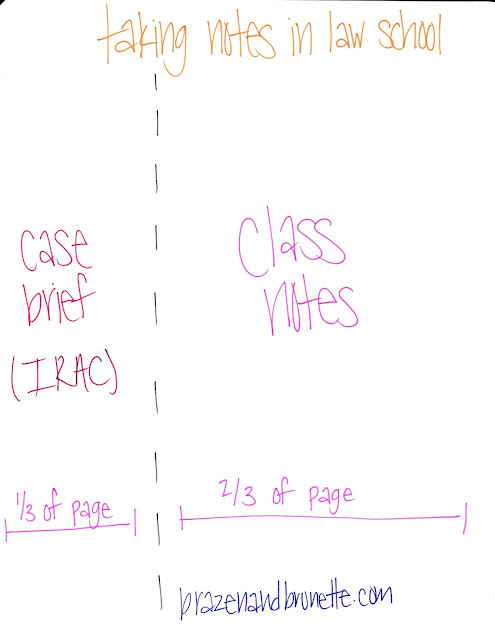
Another great thing that I took from round 2 was a suggestion on how to take notes. You've probably heard of the Cornell Method of note taking, but this professor customized that style for law school. One thing I want to work on this semester is hand writing the summaries of my chapters to hopefully help myself study more, so I'm planning on using this when I do. 

orientation: take 2 | brazenandbrunette.com

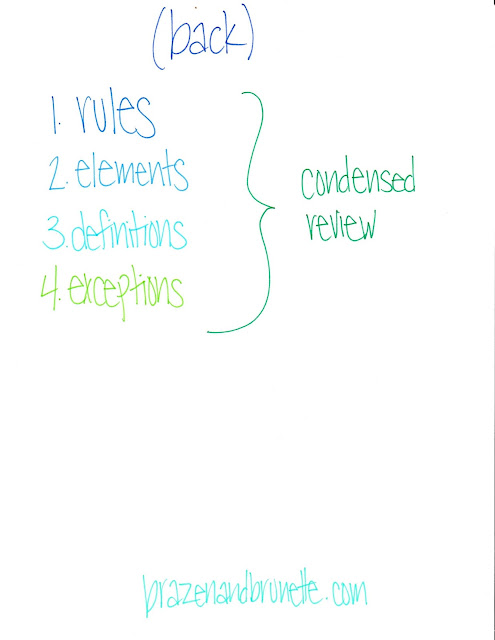
What you do is on the front split your page into about 1/3 on one side and 2/3 on the other. For 1/3 you'll have the main parts of your brief, and then right beside it on the larger half you can take notes about that brief. That way you're not switching back and forth between the two. On the back you make a summary of that case so that you'll have all this information already together and ready for your outline.

orientation: take 2 | brazenandbrunette.com


August 12, 2016

What to Wear to Law School Orientation

what to wear to law school orientation. law school outfit. orientation outfit. law student outfit. law school blog. law student blog. law school blogger. law student blogger. | brazenandbrunette.com

I just realized that I probably should've written this earlier because some of y'all have already started your orientation, but my orientation starts next week so I just thought of it (whoops). I really wish I could take pictures of the outfits that I plan to wear but my house is a mess right now because I'm about to move and also I don't own a full length mirror. 

Depending on your law school, they probably will tell you what to wear to your orientation. If you don't have a big professional wardrobe, that's fine! There's really no one to impress this week so it's ok if you wear what you have. Just keep this in mind and work these next two semesters to slowly build your wardrobe so that you're prepared to interview and work in an internship. That being said, do try to look put together because there's a good chance that you'll meet your professors this week so it's always a good idea to make a good first impression.


Business Professional

BP in the legal field is definitely more conservative and classically professional than what Pinterest will lead you to believe. If a lawyer ever tells you to dress BP, they are meaning a suit. Your school might ask you to wear this one day when you take an official oath swearing that you'll do nothing but read for a whole year (jk. but not). I already wrote a little about this in my post about what I wore in moot court, but here's some looks you can click through or shop if you want.

Related: Building a Lawyer Wardrobe


Business Casual

This is what Pinterest is talking about when it says anything about Business. Obviously, BC is a step down from BP. Basically if it's colorful or slightly casual, it's BC. I'd stay safe with either comfortable heels or a good pair of flats. I've seen a lot of people wear blazers, too. It wasn't uncommon for girls to dress BC for class because they want to look nice.

Here's a Pinterest board full of Business Professional and Business Casual inspiration


Casual 

This is what you'll probably be able to wear for most of the week. It's also basically how I dressed for class. Law school casual is still a little more dressed up than what I wore in college. I saw a few people wearing yoga pants and Nike shorts, but it's not really that common. Remember that there's a chance on any given day that you'll have to stand up and talk in front of the class; I've found that dressing nice gives you more confidence on those days. There's also the chance that distinguished judges or lawyers will be visiting your school throughout the year, so make sure that you're always prepared to run into one of them.


And here's a Pinterest board full of outfit ideas for class 


Final Thoughts

If all else fails, just glance around and see what your classmates are wearing. If they're a little dressier, you can step it up a notch. I'm by no means a law school fashion blogger, but I think it'd be a great idea if any of y'all with more fashion sense want to start that up! "What do I wear?" is a question that gets asked a lot. In the meantime, if any of y'all feel like sharing what you wore to your orientation to help future generations of 1Ls, please send it to me and I'll update this post!

Oh and one rule that I recommend for class is the 2/3 rule — between your hair, makeup, and outfit, you should always have at least 2 put together (so if you do wear an oversized shirt and nikes, make sure your hair and makeup are done). It's just a handy way to keep you from looking too sloppy.

Read more about how my Day 1Day 2Day 3, and Day 4 went! And check out my Guide to Orientation post :)

August 5, 2016

Law School Vocab

here's a reference guide of law school vocab | brazenandbrunette.com

As you're getting ready for orientation and reading your cases, you might come across some words that you're not familiar with. Don't feel like you're unprepared or behind if your legal vocabulary isn't as big as another classmates! Now is the time for you to get used to all these words that in a few months will be second nature to you. 

I decided to give you a little reference guide just in case, but don't feel embarrassed to comment or email me if a word isn't on here that you don't know because I want this to be as encompassing as possible. The words that I'm starting off with are from a list we were given at my orientation to become familiar with.


Affirmed

a judge confirms a ruling after it's been appealed

Answer

a defendant's first pleading that addresses the merits of the case

Appeal

having a decision reconsidered by either a Court of Appeals (first), State Supreme Court (second), US Supreme Court (last)

Appellant

the party who appeals a lower court's decision 

Appellee

the party who responds to the appeal


Black letter law

the straightforward and basic rule
ex. going 80 in a 75 is illegal 

Brief

a written statement setting out the legal contentions of a party in litigation 

Related: How to Write an Appellate Brief

Case Brief 

a short summary of the different components of the case

Related: How to Make a Case Brief


Chattel

a thing that you own

Citation

law school vocab | brazenandbrunette.com

Complaint

the initial pleading that starts a civil action 


Concur

a judge agrees with the outcome of the case, but not how the majority came to that conclusion

∆ (delta)

a common shorthand for defendant 
option + J on a Mac
alt + 8710 on a PC

Defendant 

a person sued in a civil proceeding OR
a person accused in a criminal proceeding 

Dicta/Dictum (plural)

someone's opinion on the case
not from the deciding judge, but still important because of the writer's authority


Dissent

a judge disagrees with the outcome of the case (and sometimes how the majority came to that conclusion, too)

Distinguish

to note a significant difference between two cases
usually is used to minimize the other case's precedential effect

Holding

a court's determination of a matter of law

Judgment 

a court's final determination of the rights and obligations of the parties in a case


K

a common shorthand abbreviation for contract 

Related: Computer Shortcuts and Abbreviations for Common Law School Words

Motion

a written or oral application requisition a court to make a specified ruling or order

Outline

a summary of everything you've learned over the semester that you use as a study guide for finals

Related: How to Make an Outline

Opinion

a court's written statement explaining its decision in a given case


π (pi)

a common shorthand abbreviation for plaintiff 
option + p on a Mac
alt + 227 on a PC

Petition

a formal written request presented to a court

Plaintiff 

the party who brings a civil suit

Prayer

a request to the court at the end of a pleading 

Precedent

how courts have ruled in the past
lower courts must follow precedent of higher courts

Procedure 

the manner for carrying on a civil lawsuit or criminal prosecution 

Remand

to send an appealed case back to the last court to fix an issue

Reversal

to overturn a lower court's decision 

§

section
option + 6 on a Mac
alt + 0167 on a PC

Stare decisis

a court in the same jurisdiction must follower earlier judicial decisions when the same points arise again in litigation

Style

the case name in a citation 


Socratic Method

teaching method where a professor cold calls a student and asks them question after question 

Related: What Class is Like

Summary Judgement

stops the case mid-trial and gives a judgment because it has been found that there is no genuine issue of material fact to proceed on 


-or/-ee

the person with -or suffix is the giver
the person with -ee suffix is the reciver

ex.
debtor - the one who gives the loan
debtee - the one who receives the loan

July 27, 2016

Six Steps to Transferring Law Schools


Wow so much to celebrate in the past week! Yesterday I finally got the news that I've been hoping to hear for over a year—that I've been accepted to my dream school.


Being as obsessed with blogging as I am, one of my first thoughts was ooh this will make a good blog post haha. I'm pathetic. The whole process turned out to be easier than I expected, but definitely made me cry stress tears along the way.


Choosing to transfer

I always wanted to transfer after I found out that there just wasn't a spot for me to be moved off the waitlist. The quote that I always kept in the back of my mind was sometimes a No is really just a Not Now. The main reasons why I wanted to transfer is that my new school is cheaper, closer to my friends and family, and truthfully is a higher ranked school

I thought about applying after my first semester but talked myself out of it because 1) I didn't know if you even can, and 2) if I had another good semester then I'd have some solid grades to support my application. Luckily, back in May I got a letter from the Dean of Admissions inviting me to apply to transfer. I'm assuming that this is a something they do for the waitlisted people because we are more on the Maybe list than the No list. 

The hard part is that my school didn't release our grades until late June and our ranks until Mid-July so I wasted a few weeks seeing if I was even eligible to transfer. I read somewhere that supposedly some schools do this to make it harder for people to transfer out because of deadlines. 

But as soon as I got my grades back and was happy with them, I called the Dean of Admissions to personally let him know that I was interested, and explained that I had been waiting for my grades before applying. He reassured me that I wasn't late in the process and informed me that they make transfer decisions fairly quickly because they review and decide your file as soon as it comes in because they know that we have to move and whatnot if we transfer. 


GPA/Rank

Obviously this is the most important thing that you need to have down if you want to transfer. Your goal should be at least to be in the top half of your class rank if you want to transfer. As a general rule, the bigger the difference in ranks between your two schools, the higher you should aim for. 

Being in the top half of my class wasn't as hard as it sounds because I just tried my best in every class and ended up with my lowest grade each semester being only one C+ (thanks curve). Having the goal of transferring already when I began my 1L year was a great motivator for me because I knew that I had my 2L and 3L years to get the grades for a job, but only this first year to get to transfer.

LSAT

The great news about transferring is that your LSAT is not as big of a factor as the first go around. When I mentioned that I was considering transferring to one of my professors, he told me this and it really gave me hope.  My professor explained that this is because schools don't have to count transfer student's LSAT in what they release, so your meh score won't hurt their reputation. 

Now I'm not saying that a 120 will get you in, but if your score was borderline the first time you might still get in. This is because they still consider it to see if you're capable of doing well on finals and the bar, because these scores do affect their reputation.

Rec Letters

Going to a professor asking for a rec letter to transfer is awkward, not going to lie. I felt like I was indirectly telling them that I didn't like them or thought that I was too good for them, which was definitely not how I wanted to come off. Luckily though, they understood that it's common for people who do well their first year to try to use that to their advantage to move up the law school ladder. 

What really helped was that law school forces you to participate in class so your professors will actually have something to say about your class performance. Another thing that helps is that the classes are smaller and you have some professors for 9 months so they really get to know you. I just scheduled an appointment with them to go over my final and then at the end brought up about how I was considering transferring and asked if they would write a letter for me. 

One thing to definitely bring with you is a school résumé with your class rank and GPA so that they know your strong points to address. And make sure that you give your professors a deadline of when you want it in before your personal deadline because they will most likely have to submit it through LSAC and wait for that to be added to your file, which takes time. 

Related: How to ask for a rec letter

Personal Statement 

The first go around, I wasn't all that confident in my personal statement. My theme was basically "why I want to go to law school," and I felt like SpongeBob trying to write about what he learned in boating school. When I started to write a new one, I instantly started to have a theme of "why I want to transfer" and it ended up sounding very forced. 

Related: Personal statement advice

Finally I decided that I hated it and wanted to start all over, and for some reason I just sat down and started writing it like I was writing a blog post, and it sounded much more like me. Once I treated the admissions committee like y'all, the words started flowing and I came up with a new theme. I took this girl's advice and used this as an opportunity to explain how I've grown this past year. 

To be honest it was tempting to mention Brazen and Brunette as an example of what I've accomplished since last applying, but I finally decided against it because I didn't know if this would make them take me less seriously since I didn't know if they'd actually come check this out or not. 

Application

Luckily LSAC saves all of your application responses for 5 years, so the application part was easy peasy. Just make sure that when you go to fill it out, you choose a transfer application instead of a regular one. Oh and of course make sure you update your information so they have a current email and mailing address for you since you've probably moved since last time. 

Another thing to remember for your application is that you'll have to send in a new transcript from your current law school. I had to email them to get them to add my law school because at first my only options were high school or undergrad. Speaking of undergrad, if you were accepted into law school before your final grades from undergrad were posted, make sure you get an updated transcript from your undergrad sent in. It took about 4 business days for my school to mail off the transcript, and another business week for LSAC to add these to my file, so get this done ASAP.

Related: What to put on a law school transfer résumé

Letter of Good Standing

This was something that I didn't even know I needed until the school emailed me telling me that it was missing from my file. I'm assuming that this means that you have no holds, have paid all of your tuition, and are still a student at your current school. I had to visit Dean of Student Records to get this. At least at my school, before I could even get this letter I had to speak with our Assistant Dean for Law Student Affairs and be approved. 

All this involved was scheduling a meeting with him to explain why I wanted to transfer and my thoughts on the school. I made sure to request that my class rank be included in this letter because my transferring school required it and I wasn't sure if it was already included on my transcript. The hardest part of this was that I was transferring at prime vacation time so it did take over a week to get all of this done. 

Acceptance

Since all my application was waiting on was this letter of good standing, I went ahead and asked that a copy of the letter be emailed to the admissions people at my transferring school. Apparently Tech had already reviewed my application and all but accepted me because within 20 minutes of this being emailed out I got an acceptance email!! 

July 13, 2016

Preparing for Orientation

What to wear, what to do, who to meet, and what to pack for law school orientation. What To Expect At Law School Orientation. prepare for law school orientation. what to wear to law school orientation. what to bring to law school orientation. what to expect at law school orientation. new law students. law school blog. law student blog. law school blogger. law student blogger. | brazenandbrunette.com

My college orientation was where we learned the fight song and where the main buildings on campus were. It was tailored to 18 year olds who are bright eyed and bushy tailed. But law school orientation is for grown ass adults who don't care enough to play ice breakers or sit around in color groups talking about peer pressure and drinking. Expect your orientation to be straightforward and business-like (but not as boring as a board meeting).


What to wear

For some reason, when people think of law school they think ~lawyer~. I saw people show up to orientation in business casual (some even in business professional) with a legal pad and briefcase in tow. But they forget that this is law school so you're not a lawyer yet, you're just a student. Even Elle Woods wore hot pink jeans and an off-the-shoulder top to orientation! If your school wants you to dress up, they'll let you know. Other than that don't sweat it and just wear something that is comfortable (you'll be sitting a lot) but also that doesn't look like you're about to workout or nap. You might also make sure your hair and makeup is on point if this is when your school takes photos for your ID. 

Related: What to wear to orientation


What to do

The stigma of law school will have you in this initial frenzy where you always think you should be trying harder. But now is not the time! I saw way too many people frantically trying to write down every word that the Dean said. This is a total waste of time! Spend most of your time just listening to what they're saying and I promise most of it will stick with you. And what doesn't stick with you is probably stuff that you'd figure out anyways.

If you're assigned any readings for like a mock class, definitely make sure that you do the reading! We had two cases and one person got called on who clearly had only skimmed it a little bit and it was awk.  


What to pack

Even though I already said don't spend the whole time taking notes, you probably should bring a laptop or at least a notebook to jot down any important dates or information that is mentioned. Bringing your planner would also be a useful idea. And make sure you bring a pen! There's always some form to fill out and my orientation actually had us sign in during the morning and again after lunch.

Probably the most important, but easily forgotten thing is snacks! I brought crackers, trail mix, and a water bottle after that first day where I almost starved to death until I bribed a girl I was sitting by to share her extra granola bar. 

Who to meet

Make sure that you meet at least one go-to person at orientation. The girl I met saved my ass on the first day of class, was my moot court partner, and always gave me notes when I missed class. Using the buddy system is also a great way to successfully tackle a networking event.  

You also might consider having a game plan when you go in (this isn't as tactical as it sounds). Right after school starts, there's essentially class elections. If you want to run for one of these positions, you'll need to get your name known because people will just vote for whatever name sounds familiar. Or if you want to be an officer in a student organization, it will also help if people know your name. So go be a social butterfly!

Final Thoughts

Ok so this is kinda unrelated but I just found a website that I think might help some of you 0L's prepare for law school before your orientation. First off, no this isn't sponsored. Second off, I checked and it's free. It's this website called LearnLeo and it's just this really simple, easy thing that takes like 15 minutes of you time and just explains to you what things are and what to expect at orientation. You just make an account with your school email and then it has little tutorials on Law School Prep. 


preparing for orientation | brazenandbrunette.com

For a more in-depth look at how my orientation went, check out my posts about Day 1, Day 2, Day 3, Day 4, and Day 5!

August 22, 2015

Law School Orientation Day 5

What To Expect At Law School Orientation. prepare for law school orientation. what to wear to law school orientation. what to bring to law school orientation. what to expect at law school orientation. new law students. law school blog. law student blog. law school blogger. law student blogger. | brazenandbrunette.com

Advice from Professors

For the final day, we recapped over book briefing, case briefing (IRAC), and outlining. One professor mentioned that although it's not against the rules in any way to use someone else's outlines or dividing outline responsibilities within a study group, that won't always be helpful because the importance of these is in what you learn as you figure out what to go in it. He also warned that every year there's at least one person that asks a question about a topic during a review session, and the professor didn't even teach on that topic so essentially that student wasted their timing learning something that was't even on the test. He suggested looking at them for help when you get stuck rather than just skipping the homework since you already have the answers. I was having PNM flashbacks again to when everyone was three steps ahead of me because family and their friends had already gone through this process and were helping them along the way; meanwhile I'm sitting here clueless and oblivious and helpless. This guy in my area said he even had his grandpa's outlines! That's just crazy to me. 

Also, the Assistant Dean gave us some good advice about what to ask mentors. Namely, to ask what they really like and strongly dislike about their jobs. And if things go well, network through them and ask if they know of 1-2 other attorneys that you can speak to.


Questions to Answer

We also watched the opening scene of The Paper Chase to show the simple questions to be prepared to answer in class such as: 


  • What happened in the case? 
  • Who was suing who and why? 
  • What was decided by the case? 
  • Why the judge used a rule
  • How a judge used a rule 
And also what questions to ask yourself after class as you fill out your outline such as:
  • What are the black letter rules and definitions that you will be responsible for on the final exam?
  • How did your professor break down the elements of these definitions and how did your professor define the terms within the definitions?
  • What facts did your professor use to apply the various definitions and what legal arguments were presented when discussing each definition?
  • What aspects of the material covered today do you still not understand?
A 3L explained how he would write his briefs in blue pen, (it's said to help you retain information better) and take class notes on the side in black pen. This helped him from rewriting in class notes what he had already written in his briefs, and also allowed him to see what the difference was between his notes on the book and what the professor had to say.

Outlining

This is the broadest form of notes and allows you to study your notes instead of re-reading the books for the exams. Book briefing is the marginal notes/ highlighting/ underlining that you do in your book, which you use to fill out your IRAC brief, which you use to make your outline. Ideally, you will have an outline for a specific case, an outline for a specific chapter, and an outline for the class as a whole. Broken down, it looks like this: 

Specific Case Outline
  • Servant
    • definition (elements that must be proven)
      • one
      • two
      • three
    • examples
      • A hires B to help him wash his car
        • B is A's servant
      • These will be hypothetical questions that your professor brings up in class
  • Tort Liability
    • Respondeat Superior
      • an employer or principle is liable when....
    • Principal's Tort Liability
      • one
      • two
      • three
Chapter Outline
  • Agency
    • Who is an agent
    • Liability of principal to the third party in a contract
    • Liability of principal to third parties in tort (this is the above example)
    • these will be headings and subheadings in the table of contents
Class Outline
  • Agency (above example)
  • Partnerships
  • Corporate Debt
  • these should be organized according to the syllabus and your professor's order rather than in the order of the table of contents

Book Briefing

I got started on my readings for the first day of school (31 pages for contracts, only 16 for torts) and here's a little what my book looks like. To read and summarize main ideas as I go, I'm right at a rate of about 4 pages an hour. I know that's painfully slow but everyone says you get faster with practice so I'm not too worried right now. My plan is to use my Fridays off to help out with all of the extra reading and note taking.


law school orientation day 5 | brazenandbrunette.com

Final Thoughts

Read more about how my Day 1, Day 2, Day 3, and Day 4 went! And check out my Guide to Orientation post :)

August 21, 2015

Law School Orientation Day 4

What To Expect At Law School Orientation. prepare for law school orientation. what to wear to law school orientation. what to bring to law school orientation. what to expect at law school orientation. new law students. law school blog. law student blog. law school blogger. law student blogger. | brazenandbrunette.com

What I Wore

Today was the day that we had to dress business casual for taking a pledge to be official students in what really reminded me of the pledge I took the day I joined my sorority. Right before I needed to leave, I got dressed and then accidentally got deodorant on my satin shirt from Express (pictured, because I fixed it!) and my attempts to clean it just made it worse. So I ended up wearing my dress suit pants and a chiffon button down. My mom suggested just wearing my suit jacket to cover the deodorant grease, but I felt like with the jacket would make it too business professional. I'm glad I decided against this because almost every girl was wearing either a pencil skirt with a blouse or suit pants with a blouse. However, I did see a few girls who either were wearing too short of a skirt, too tight of a skirt, too low-cut of a top, or too high of heels. Last spring, I was walking through the Dillard's Spring Sale and found a pair of Giani Bini shoes that are perfect. They're black leather, with 3 inch heels and lots of padding so they're all around comfortable for long-term wear.

Related: What to wear to orientation 


#nonewfriends

Day 4 was kinda rough for me because although I've met some nice people, I haven't had instant best friends like I did at the beginning of my undergrad thanks to my sorority. I'm hoping that once I rejoin Phi Alpha Delta I can meet more people that can be genuine friends. It's difficult also because I am 6 hours away from my school, and today I really noticed how other schools are much better represented here. At one point, I was surrounded by at least 12 people who were all bonding over the fact that they went to the same school. Honestly it is making me really homesick for my old school because every single one of my friends are either still in undergrad there or are in grad school there; and then there's me. You know how during her first semester Elle Wood's only good friend was her manicurist and she had to sit alone in class? Yep, that's me.

Talking With 3Ls

During lunch after our pledge, they sat 3 3L's at every table and I got to talk to them. It was frustrating when I would as one a question about how they do something and over and over again I would get, "It just depends. Everyone is different. You just have to figure out what works for you." Hellooo I know this but I asked how you do something so I can consider if it's a good tactic for me or not. I did find out that apparently the 3L's only had a 1-day orientation, the year before me had a 2-day orientation, and this was the first year that they decided on a full-fledged orientation. Other people at my table kept asking them about whether or not they should get involved in student organizations, and how to time manage with being in student organizations. I was in a sorority and a pre-law fraternity so I'm good with making time for chapter meetings, but I guess a good portion of my classmates weren't that involved in college. 


Final Thoughts

One of the 3L's got excited because she said that she was in Section A too and maybe it's the inner PNM in me, but I really want to know if there was a method to the way they broke us up into sections and subsections for our Legal Research and Writing class... A girl I sat with and I looked up our professors on rate my professor and all of them were at least 4/5 and were ranked really high for clarity and helpfulness, just not so much for easiness (which is to be expected). We also got official leather portfolios today so I feel super official now. 

Also, our professor broke down the "hard curve" that will be in our class and it went like this:


There's about 75 students in my section
He'll consider our one grade from the final and our overall performance in class and number us 1-75
#37 gets a B-
About 10%, or 7 whole people, get B+ to A's
About 10% get C- to F's

I'm comforted knowing that only 7 people will fail, but I'm discouraged that there's a really good chance that I'll be a C student :/


Final Thoughts

Read more about how my Day 1, Day 2, Day 3, and Day 5 went! And check out my Guide to Orientation post :)

August 20, 2015

Law School Orientation Day 3

What To Expect At Law School Orientation. prepare for law school orientation. what to wear to law school orientation. what to bring to law school orientation. what to expect at law school orientation. new law students. law school blog. law student blog. law school blogger. law student blogger. | brazenandbrunette.com


What I Wore

Hump day. Wine Wednesday. Third day of orientation. Yesterday I ended up wearing what is technically a tailgating dress (more commonly known as a plain colored sundress) because I figured it'd be a safe choice. While I wouldn't say that I was overdressed, I will say that I was jealous of the girls in jeans and a nice top. But that's probably because the building was freezing. And that's exactly what I wore today- we definitely all were rocking skinny jeans because they look a little more polished than bootcut. Also, when I last watched the orientation scene of Legally Blonde, I thought it was unrealistic that someone would get a Masters or even a PhD before going to law school. I was wrong. About half of my class is like me, fresh from graduating either last spring or last December. The other half either have gone on to get a graduate degree or even worked for several years before attending law school. A lot of people are married too! I wasn't really expecting so many people to be more accomplished in life than me. 

Related: What to wear to orientation 


Premises and Conclusions

Once again, all today basically was a how-to law school again. We went over premise and conclusions because apparently that's where a lot of points are lost on essay answers. In short, premise + premise = conclusion. Here's the example we went over:


  • In order to be violate a speeding law, one must be operating a motor vehicle at a speed which exceeds the posted speed limit.
    • Element 1-operating a motor vehicle
    • Element 2-traveling at a speed excessive of the posted speed limit
  • Jane was driving her car at a speed of 95 miles per hour in an area with a posted speed limit of 65 MPH
  • don't say Jane violated the law because she was speeding
    • This just jumps to a conclusion without giving any premises, a big no-no
  • instead say Jane was operating the motor vehicle, satisfying Element 1 (premise). Jane was driving in excess of the posted speed limit, satisfying Element 2 (second premise). Because both Element 1 and Element 2 were satisfied, Jane was violating the law (conclusion).
    • obviously though, in real life you wouldn't have "elements," but you get the point


Book Briefing

Yesterday, I mentioned briefs and today we went over book briefing. Book briefing is marginal notes/ highlighting/ underlining that you do in the book as you read it. After you read your assignment, you can take your book briefs to fill out your IRAC. One professor suggested briefing on weekdays and organizing your briefs, along with class notes, into outlines on the weekends. Some important notes to take are:
  • find out who was who (plaintiff and defendant) in the original case
    • find out who was who in the appeal
      • find out who was who in the Supreme Court (if it goes that far)
  • summarize the main point of each paragraph as you go
  • connect summaries as you go
  • find out who is suing who and why
  • list all of the characters in the case 
    • witnesses
    • other parties
    • victims
  • list all words defined in the decision
  • make a vocab list of all unfamiliar words (with their definitions)
  • note all outside cases cited
    • how they are relevant
    • not necessary to look up & read these cases


Legal Writing

Lastly, we went over legal writing and to sum up a pretty boring hour: write clearly and concisely. While we were going over this, I noticed that a lot of the girls in the row in front of me were sneaking Core Grammar assignments to get them done. I'm extremely grateful for always being such a grammar nazi because I watched these girls work for a long time just to accomplish what I did last night while waiting for my towels to dry. 


Our Syllabus

We also found out how to navigate the website to find our professor's syllabi, so I took a look at them and a lot are pretty strict. Every single one counts you showing up to class "unprepared" as an unexcused absence, and some lower you a half grade after two unexcused absences. One professor banned all electronics, which really bums me out because I'm obsessed with EverNote. Another professor requires a hard copy of briefs to be turned in at every class. And the reading for each class is about 20 pages, starting the first day of class. So that's how I'll be spending my weekend, cracking into briefing my first books on top of finishing up Core Grammar. 

Also, our school's email is set up through Outlook and I'm having a hell of a time setting it up on my phone and laptop. I really hate the setup of outlook and how complicated it is, and hate that I don't get notifications instantly when I get an email. I hope I can get this set up before class starts so I don't miss any assignments. Mac > PC all the way


Final Thoughts

Read more about how my Day 1, Day 2, Day 4, and Day 5 went! And check out my Guide to Orientation post :)