Showing posts with label reading. Show all posts

February 12, 2017

A Law Student's Study Schedule

As a law student, I spend 7 hours every day either in class or reading for class... | brazenandbrunette.com

To be honest with y'all, last semester was probably the easiest semester I'll ever have in law school. For two of my classes there was practically no reading. If you're a 1L, you'll know how amazing and rare that is. And for the other two classes, the reading was very light and only took about an hour and a half each day. In case you don't know, that's way below normal. On top of that, I didn't even have Friday classes at all. It was so easy I kinda regret not saving it until my last semester, but I was grateful to have this as an easy transition semester into my new school.

This semester is completely different. I realize that the "work you to death" of the saying is referring to more extra circulars than classwork. I know a girl who is on a journal and in a clinic. And another girl who participated in a national competition for the Board of Barristers and also is on a journal. How they do it, I have no clue but I feel bad for their sleep schedule/social life. But my semester is still kicking my butt. I'm taking two procedure classes and just like Civ Pro all class consists of is rules, rules, rules. And I have two other classes that are really rule heavy. Only one of my classes is just a normal, read the case and find what you should know. In case you're keeping track, yep that's 16 hours that I'm taking.

So all of this has made me into a more responsible person. I am now one of those people who gets to the library at 9 am and reads before class, then spends her lunch break in the library eatings and reading before my next class, and then staying after my last class to do a little more reading. For the past year and a half I just couldn't stay at school and focus on studying for so long at once and instead would go to class, come home and have a break from the law, and then would study before going to bed. But now as a 2L, professors expect me to cover a lot more readings each night. One of my Tuesday/Thursday classes goes through a chapter a class! On top of that, all of my classes but one require me to have a statute book and a case book so this semester I'm lugging around 9 books!


snapchats of a law student | brazenandbrunette.com

snapchats of a law student | brazenandbrunette.com


New semester, new study habits

I realized that I had too much reading to use my old study schedule so I switched it up to fit this semester and I'm very happy. Here's why I'm glad that I switched from class-relax-study to study-class-relax. First off I've noticed that once I just accept the fact that I'm a nerdy try hard and embrace the library, I get a lot more done because my motivation is higher when I just keep studying rather than allow myself to slack and then try to find motivation again. Also I can enjoy my chill time a lot more when I know that I'm not about to have to start reading again. I also sleep better now because instead of procrastinating and staying up late reading, as soon as it hits my bed time it's lights out. For sure tho the best part is just being done in the afternoons and not having to think about school for the rest of the day!

Since this is an update, I decided to show y'all what my typical day is now because it's changed a lot since I was a 1L. Specifically, because I get to the library early and read during my breaks, once I leave the school I'm usually done with studying for the day and have the rest of my evenings to myself. If you're curious how my daily schedule was when I was doing a class-relax-study schedule, here's my previous post A Day in the Life of a Law Student. And since I haven't posted a "snapchat of a law student" in a while, journey with me through this Wednesday and see what it's like to go from 9-4 without a break. Studying = major key.

Reading - Trial Procedure

snapchats of a law student | brazenandbrunette.com

Even though my first class isn't until 11, I try to get to the library by 9 and get to going. For my Trial Pro class I had to read pages 115-136 and 170-174. My readings still take me a while, mainly because I have to take a lot of notes about the steps for a part of trial from the book so it slows me down.

Reading - Evidence

snapchats of a law student | brazenandbrunette.com

As for evidence - I normally have that class on Monday's and Friday's and during this time I'll do my reading. Since I don't have it on Wednesdays but I'm at the library anyways, I use this time to type up my notes from my book and class notes since my evidence professor doesn't allow laptops in her class.

My local book store sells notebooks with an extra-wide margin and I'm really starting to love it because I can use the "Cornell method" to take my notes. The bookstore calls this "law margin" but you can find them as Cornell notebooks if you're interested in getting one. On the left side I'll put the black letter law and on the right side I'll elaborate more and add cases and examples.


a law student's study schedule | brazenandbrunette.com

Related: How I Take Notes

Class - Trial Pro

snapchats of a law student | brazenandbrunette.com

One thing that I've noticed that I like about reading an hour or so before class is that all of the information is still fresh in my mind so if I get cold called to go over a case, I'm not as likely to get it confused with any of the other cases.


Lunch/ Reading - Criminal Procedure 

snapchats of a law student | brazenandbrunette.com

I used to drive home for lunch since I get an hour and only live a few minutes away from school, but I've gained like 30 minutes back in my day since I'm not walking to my car and driving home and then driving back and walking back to school. It's a little thing, but I'm glad I'm not wasting time anymore.My school has study carrels in the library so I have my own that I share with 3 other transfer students. I bring my lunch and then will just hole up in my carrel and read for later that day. For my crim pro class I had to read pages 199-232. 

Last semester when I was studying mostly at home, I just used my study carrel as a locker to store all of my statute books. Now that I spend all day at the school, my carrel has become my own little room so I've started storing the essentials there. Here's what I keep in mine (besides the obvious 20 books) -

Book stand - after reading for a few hours in a row, my neck will start hurting from looking down so this sets my book up so I can read without straining my neck
Travel lotion - some law books have this weird paper that dries out my hands
Travel Tylenol - for the rough days
Jacket - I made sure to get one that's a full zip instead of a pullover so that it won't mess up my hair. I also went ahead and got one that's a size too big so that I can use it as a little blanket when I don't want to full on wear it
Small hair brush - since I'm at the school all day I always end up needing this. I also keep a spare hair tie and a few bobby pins as well
To-go eyeshadow and travel-sized mascara - ok not going to lie already once this semester I was running late so I had to quickly do my makeup at school since I had a meeting with a professor and didn't want to look like I just woke up. This eyeshadow is surprisingly good!
Snacks - I usually alternate between trail mix and peanut butter crackers for the days when I'm extra hungry

Pro Bono/ Reading - Professional Responsibility 

snapchats of a law student | brazenandbrunette.com

On Mondays, Tuesdays, Thursdays, and Fridays I normally have Evidence at this time, but that class doesn't meet on Wednesdays. Since I had an hour break, I signed up to get some pro bono time in. I'm not sure if other states have it, but in Texas how I get my pro bono is through volunteering for a legal help website. 

What it is is a website where people can find forms to do legal work for themselves for free if they can't afford a lawyer. I'm basically like customer support where if someone can't find what they're looking for they go to this chat and I find it for them. Like for example, they're wanting a divorce but don't know where to start so I'll send them links to our information sheet on how to file a divorce yourself and send them the forms they'll need to fill out. It's pretty easy because all you have to do is listen to their problem and then figure out what they're needing and connect them with it. Also, it's an easy way to get a lot of pro bono hours because for this semester and last semester I've been getting in two hours every week so that adds up fast.

Related: 8 different ways to get pro bono hours

I also get some reading in while I'm doing this. Usually while I'm waiting for them to type out what they're looking for or whatever, I have time to read a few paragraphs. I do my professional responsibility (it's an ethics class that's required by the ABA) reading during this hour because the reading is easy. On this day I just had to read pages 185-196 and then IRAC out a problem issue.


Class - PR

snapchats of a law student | brazenandbrunette.com

I have the same professor for evidence and PR which I don't mind because my professor is great, but unfortunately she doesn't allow computers in this class either. PR is my favorite class this semester because most of the time we'll read a hypo and then people will debate over whether this lawyer broke a PR rule or not, and then discuss what we'd do in this situation. It's a lot more relaxed than your typical cold calling or going over cases in a lecture. Last semester I was in a group project for my Wills class and now 2 of the members from that group are in my evidence, PR, and crim pro so on Mondays and Fridays and we have 3 hours worth of class in a row together. This just goes to show you to always try to get along with your group!

Related: Everything you need to know about the Multistate Professional Responsibility Exam

Class - Crim Pro

snapchats of a law student | brazenandbrunette.com

My latest class this semester is my Crim Pro and if my professor wasn't so engaging I know I'd be falling asleep during it just because it's right there at the mid-day slump. This professor in particular is very traditional and when he cold calls on you, he still does a full socratic method. The socratic method has gotten easier for me after my 1L year because now I know what professors mean by their questions so I spend less time trying to figure out what they are asking and can just go straight to thinking about what the answer is. But I still pull up the case briefs in class just in case.


snapchats of a law student | brazenandbrunette.com

And finally by 4 I'm done for the day. Since I'll get to the library early again the next day, once I'm out of my last class then I'm done with reading for that day and have from 4-10 completely free (on my Tuesday/Thursdays I get done at 4 but stay at the library to work on anything that I didn't get done that morning or get started for my Wednesday/Friday assignments). I've found that I like this so in the evenings I don't have to be stressed over needing to read and doing chores around the house. I also like that I can just mentally check out from the law and return to a normal civilian life instead of having to be a law student practically all day every day.

Weekends - Review

snapchats of a law student | brazenandbrunette.com

I started out this semester again trying to read a little on the weekend so I don't have to read as much during the week, but now that I'm better about working my reading in throughout the day I no longer do that. However I will admit that the one downside that I've found about only reading before/in between classes is that sometimes there's a time crunch to get the reading done in the allotted hour. The times that I've had this problem was when the material was particularly tedious.

Now what I do on the weekends just depends on what all material I've gone over during the week. Since 4/5 of my classes are heavily dependent on memorizing codified law, I usually will make flashcards for the rules I just learned. Later, I plan to switch to spending some weeks doing this and on other weeks I'll just simply review the flashcards. Since half of my classes are core classes, I usually try to watch a video from Quimbee if they have one about whatever we went over in class this week. I also will eventually get started on my outlines and updating them, but it's too soon for me to get started on that yet. 

Related: How I Study on the Weekends


October 14, 2016

How to Highlight a Law School Casebook Efficiently

how minimalist highlighting can be more efficient and help you learn to read cases or fact patterns faster | brazenandbrunette.com

Once upon a few months ago, I made a post about the best highlighters for law school and showed y'all how I color coordinated my colors to the parts of the case. And then later in my post about how to make an outline, I showed y'all a picture of my highlighted book and was like only highlight what's crucial. But yesterday my professor handed out a case for us to read that she printed off from Lexis and last night after I had read and highlighted through the case I thought to myself, damn I'm pretty good at this. So I decided to maybe share my wisdom.  

It sounds very trivial, but effective highlighting is teaching your brain how to quickly read and analyze information to find out what's important and what's not. If you've taken a timed issue spotter question already, then you know exactly what I mean (and if you haven't then just trust me on this one). When you get out in the law world, you're not going to have condensed cases. Instead it will be your job to read a lot of information in a short amount of time and pick out what's relevant and now's the time to get good at that. 

how to highlight efficiently | brazenandbrunette.com

I recently saw this on Pinterest and honestly it annoyed me because you can highlight and still actively read, just if you do it right. And if you have 100 pages to read a night, jotting down notes and summaries in the margins will take literal hours. So here's how. 

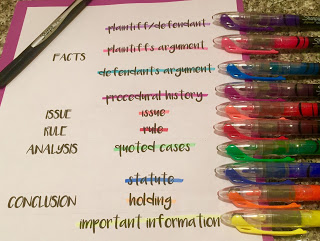
Test it out. Read only the what's highlighted in blue in the case below (it's super short, I promise!). Read it and try to avoid all of the other unhighlighted words. It might not make perfect sense because I don't highlight every word, but I promise you'll figure out what it's saying. Read only the blue and ask yourself if you feel like you understand what is happening in the case and if you could easily retell it to a classmate or professor. 

PS it's all in one color because I read this case rushed and didn't have time to find all of my highlighters to color code it like I normally do to make it even easier 

how to highlight efficiently | brazenandbrunette.com

how to highlight efficiently | brazenandbrunette.com

how to highlight efficiently | brazenandbrunette.com


How'd I do for condensing 3 pages down to less than 300 words? By the end could you pick out the plaintiff problem, defendant's argument, issue, and holding? Just imagine if I'd only highlighted about the plaintiff in pink, and only highlighted about the defendant in blue, and only the holding in orange or only the rule in red. It would be even easier to pick each of these parts out! 

how minimalist highlighting can be more efficient and help you learn to read cases or fact patterns faster | brazenandbrunette.com

What makes it effective highlighting is when you cut out details, irrelevant information, and even connector words. Yeah it might not seem like it makes sense, but JSUT 4S YU0R BR41N C4N R34D 7HI5, it can figure out the meaning of a sentence if you only highlight a few words. Another tip is to not highlight punctuation. When you go back through and reread it, these gaps in highlight help break up what's needing to be said so then the periods become redundant.  

One super helpful benefit to this is if you read a case and then your professor gets behind and doesn't talk about it until days later, a quick scan over it will remind you of all you need to know. That's actually a really good way to make yourself start being a minimalist highlighter is to highlight it thinking that you'll only have a minute to read everything that you've highlighted. When you're in a time crunch to quickly read something, you'll only read what's vital- so highlight like this! 

I hope this helps some of you over-highlighters streamline your process and get through your readings faster! I really think it helps :) 

September 7, 2016

The Difference Between Being a 1L and 2L in Law School


Sorry I've been terrible at keeping up with my Sunday, Wednesday, Friday blogging schedule! It's only been 2 weeks and already the days are flying by. I swear for as fast as college flew by, law school is soaring by even faster. When I was walking to my last class, it dawned on me that after this semester I will be HALFWAY through law school already! That's just too soon! I'm definitely not ready to face the Bar and job market yet :/ Anyhoo, thought I'd write a little post about the transition from a 1L to a 2L.

I think the best description of law school is that your first semester 1L year is like freshman year all over again, your second 1L semester is like a sophomore year, and by the time you get to a 2L you're already a junior. I say this because that first semester is really the most stressful adjustment that I've experienced so far. New school, new professors, new learning techniques, new classroom structure, new grading style. It's all just so new and can be really overwhelming at first. But when you come back from Christmas break, it's no longer new. You're still getting adjusted, but by then you're in the swing of things. As a 2L I really do feel like so much older and wiser compared to how I was as a 1L. 


The Good

One great thing about being an upperclassman is that by now I've got this whole law school thing pretty much down. Last week it only took me 2 hours to thoroughly read 50 pages worth of text and cases. If I was still a 1L getting used to the amount of readings that law school requires, this probably would've taken me an entire afternoon. The only upside to reading this much so often is that you get quicker at it.

Related: How to make a study schedule

Another plus about being an upperclassman is that the curve actually gets easier after the first year. I'm sure this is to weed out all of the people who either don't seriously want to be lawyers or just don't have the dedication to do all of the assignments. At my old school, the curve as a 1L required that the average grade be a B- and for 2L's it was a B. Here, the curve for 1L's was a C and now it's all the was up to a B. I've survived the curve for two semesters so I'm not really scared of it anymore, but that is very comforting to know.

Related: All about the law school curve

It also seems like there's more opportunities as a 2L. A lot of clinics or positions aren't even open until after your 1L year because that year is supposed to be dedicated to getting used to law school. But now as an older student I get preference for these over any 1L's, because of my experience and that they know I won't flunk out if I take on another project.

Related: Law school clinics

The Bad

Obviously the most stressful thing of being a 2L is that now it's really time to get serious about getting a legal job. Non-law-related jobs aren't really an option any more because I always need more job experience. And now I'm competing against people who clerked last summer or are even still doing it. I'm fortunate that firms usually prefer a 2L, but I still feel the pressure to get something lined up already.

Related: How to find a legal job

An unfortunate downside to transferring is that I'm kinda behind. I know a lot of people who are officers in their organizations or write for a journal, but I wasn't here last spring when these positions were available. I also missed out on all of the scholarships because their due dates were before I was even accepted. So now I have to go to all these info sessions with the 1L's to try to catch up.

Related: What it's like to transfer law schools

Overall

I think the reason why being a 2L isn't nearly as bad as a 1L is that you have so much more confidence. As a 1L I constantly felt like I wasn't good enough and that I was just faking being smart. But now I've passed a full year with pretty decent grades so I have the been-there-done-that confidence. That's not to say that I'm invincible, though, because I still spend all class hoping that I don't get called on even though I read the cases because it's so nerve-wrecking trying to answer the professor's trick questions. I know this post wasn't long, but this is all I've noticed these past two weeks. But I'm sure there will be a lot more new experiences that I'll face as a 2L. 


Related: 2L year in review

Snapchats

2 weeks as a 2L | brazenandbrunette.com

2 weeks as a 2L | brazenandbrunette.com


August 28, 2016

How to Make a Study Plan for Law School

how I come up with a plan on what I need to read for law school. law school studying. law school study plan. law student study plan. law school reading plan. law school scheduling. law school advice. law student tips. law school blog. law student blog. law school blogger. law student blog | brazenandbrunette.com

Organize your syllabus

The best way to tackle the amount of work you'll need to do this semester is to first get organized. I recently came across this post on organizing your syllabus and I'm a big fan! I like being able to see everything that I need to do all in one place, and it makes it super easy to just copy down that week's to-do's in my planner. (ps - on the syllabi, the date listed will be the due date)

Once you've seen what you need to do, make goals for how to handle the bigger tasks. My own personal plan is to read daily before class, alternate weekends to either update or review my outline, and create summary review pages every month. The point of making goals isn't to just say "This is what I want to do this semester;" it's to give you something to hold you accountable and remind you to not procrastinate.

Related: Goals for a new semester of law school 

Be realistic with yourself

Again this is before you even start studying, but you need to take 5 minutes and think about your study habits in the past. Chances are, you used to study just okay and now you need to up your game and figure out how to be on top of the ball. Things to consider that might have been a weakness that you need to address: paying attention while reading instead of passively highlighting everything, retaining what you read after a few days, motivation to actually study, procrastinating. 

Think back to how you study for finals and admit what was your biggest obstacle. If you start reading and think ok I need to make sure that I only highlight what's important, and as you're  reading asking yourself is this important enough to highlight? then you are confronting the issue of passive reading, for example.

Experiment with different study styles

You also can consider switching up how you study. Some people prefer to get all of the studying done at once to clear up their evenings, but I personally need a mental break in the afternoons after class before I start reading in the evenings (but I am aware that if a reading takes longer than anticipated, there's a higher possibility that I'll get tired and not read as well). The other day I tried studying with my friend, and she has to listen to basically stoner music to keep her relaxed as she read. But I need absolute silence when I read or I'll get distracted, so I ended up spending 2 hours to read 10 pages. 

Related: My law school study schedule

This also brings up the point that I have to study alone. Being in a public place like a coffee shop or library will just distract me by even the slightest noise. But for other people, the temptation of watching tv or cuddling up in bed and sleeping is too high so they have to go somewhere where's there's not those temptations. I'd suggest during these first few weeks to experiment and see what helps or hurts your studying.

Motivate yourself

I'm saying this because if you sit around and wait to study for when you're super motivated, you're not going to get much done (hello, procrastination). For me, I have to plan out productive days. Since I have a 3-day weekend, I use my Fridays as my get-shit-done days. I wash dishes, do laundry, and pick up around my place while my friends are in class. Then on Friday evenings we go out and have fun. This leaves my Saturdays open for laziness. I'm not just talking about being hungover, but part of me does need a "recharge day" where I can just binge watch Netflix. By the time Sunday rolls around, I have no excuse to not study because after a day of doing nothing I'll be in the mood to be productive, but my apartment is already clean so all that leaves left is to study. Did I put too much thought into this? Probably, but it's what works for me so that I have no choice but to get everything done that I want/need to.

Related: How to balance your time in law school 

Get organized

Whenever it is that you sit down to study, whether it be an all out catch-up day or the day before class, make a list of everything that you need to get done. I personally like to do this in my planner and make little boxes to check off as I go. This helps make sure that after reading 20 pages for one class and 12 for another, you don't forget the 2 page handout a professor gave you as you were leaving class.

I personally don't suggest getting ahead on the readings, because it defeats the purpose. It should be that you kinda self-teach yourself an intro on a topic, and then go to class to have it better explained and burned into your memory. But if you're reading Friday's topic on subject matter jurisdiction and then going to Monday's class on personal jurisdiction, you'll have SMJ fresh on your mind and easily get it confused with PJ. 

I also don't recommend that you split up your readings too much. What I mean by that is if you have 30 pages to read in contracts and 20 pages to read in property for Monday, that you don't read 15 and 10 pages of each class on Saturday and again Sunday. It would be better to read all for one class on Saturday and all for another on Sunday because you usually need to read one assigned chunk at a time to understand it. 

Study

One of the best ways that I've found to actually make myself study is to use the timer method. I'll turn my phone on Do Not Disturb and then set a timer for 25 minutes. I don't allow myself to do anything but study until that alarm goes off (including reading a text). During finals time, I'll get more strict and even pause the timer when I get up to go to the bathroom or something, just to guarantee that I'm studying for the full required time. 

After my alarm goes off, I'll set a timer for 5 minutes and then I have a break. Sometimes I'll get on social media, but usually I'll let myself watch a little bit of a show during my break. No matter what, when that timer goes off I make myself go right back to studying. It's easier to finish a break knowing that I'll be back in 25 minutes to pick up where I left off. And then every few hours my break will be 30 minutes. Usually during these big breaks I try to be productive and shower or cook for myself. I've found that being rigid with myself during the study parts is the best way for me to get through my to-do list for the day. 


let's be friends!


August 17, 2016

How to Read a Law School Casebook

how to read a law school casebook. studying in law school. how to make a law school brief. what is a case brief. what's the difference between a case brief and IRAC. law school tip. law school advice. law student blog. law school blog. law student blogger. law school blogger. | brazenandbrunette.com

Hello lovelies! So I'm sure lots of you have been sitting for hours on end at your orientation listening to some professor or academic advisor or dean talk about how to read for class. That's fine and all, but I thought I'd give you a more peer-to-peer perspective. 

The reason why I decided to write this post is because I sat by one of my friends during orientation when they went over how to write a brief, but then that evening she started to get frustrated because she still felt like she was doing something wrong. My first instinct was to pull up that same case on Quimbee and have her see what their brief said. This only confused her more so when I went to help her again, I realized that all of her confusion was because she wasn't reading the case the correct way.

TL;DR, I hope this post helps you better understand how to read a case so that you know what's going on and what to put in your brief.

So probably your school has told you that you need to brief or make an IRAC about your case. That's great, but you need to know where to find this information in the case!


Procedural History and Facts

Ok so this can be tricky to separate. First things first, find in your case where there is a capital name followed by a j, like BOYD, J. (FYI: j stands for judge or justice). Anything BEFORE this you can consider a prologue to the case. This before section should never be in your holding or reasoning. This is background info that the authors of your casebook had to include so you'd know what was going on in the actual excerpts from the case. Usually this is where you can find the history and facts. But also to be tricky sometimes they discuss the history and the facts later on throughout the case so your author didn't need to talk about it here.

Procedural History is this:

  • Trial Court 
    • who sued who and under what legal theory (why)
      • ex. Joe sues Dave for battery
      • NOT Joe sues Dave because Dave beat him with a bat (these are the facts)
    • who won and why
  • If the case was appealed already, then repeat the above information again for the 2nd trial
That's pretty much all the procedural history will be. Most of the rest that you'll want to put here are actually facts. People in class will always blab too much on the facts and get cut off my an annoyed professor during the first weeks. Be better than them and cut to the chase. See how above all I had to say was Dave beat Joe with a bat? I didn't have to go on to describe irrelevant details like where they were or what kind of bat it was or list all of Joe's injuries. 

What's tricky at first is deciding what is relevant and what is not. The easiest way to do this is fill in your facts for your brief last. If the whole case was whether Dave can be held liable because he is a minor, then yes their ages matter. If the case centered on Joe's wife being emotionally damaged from watching the beating first hand, then yes who was there matters. But if the case is about whether or not Dave actually even touched Joe, then their ages and the audience does not matter. If you don't mention a fact that your professor wanted from you, he'll ask you about it and then you can talk about it. Don't feel like leaving out details makes it seem like you're unprepared!

Issue

Ok now after the BOYD, J., this is where the actual case is. As you're reading a case, keep an eye out for the term "whether." This is usually a good indication that the judge is about to state the issue. An example of this is "the court must decide whether the defendant either willingly or knowingly violated the statute."

What the issue is NOT is should the plaintiff win/did the previous court err in their finding.  Sounds obvious but on my first day people actually raised their hands and confidently stated that that was the issue.

If you ever read the case and cannot for the love of God decide what they're even debating on, then again leave this blank and come back when you've finished with the holding and reasoning. The holding will be the answer to the question so by logic if you know the answer you should be able to figure out the question. 

An example of this would be if the judge says that the court is ruling in the defendant's favor because he did not willingly trespass. In this case, the issue might be whether or not the defendant trespassed.

Rule

The rule can also be tricky to find because sometimes the judge just doesn't say it outright (which would be black letter law) so you have to infer what the rule is. Typically if a case doesn't state the rule, then your professor will ask about that during the Socratic Method. 

Let me take a quick detour to explain the difference between a rule and elements.

Rule: $10 pizza special
Elements: 1.medium sized pizzas only 2.one topping pizzas only 3.carryout pizzas only

In your brief, the $10 pizza special would go in the Rule section and the elements would go in the Analysis section. This is because the reasoning for why the rule applies is that the elements are met. But when it comes time to make your outline, both the rules and the elements should be included.


Analysis 

Lol just explained that! Legal analysis is fairly easy to find and put in your brief. If all else fails just read the verdict and ask yourself either how the judge came to that answer or why he did. 

What you need to do when you come to this part is pay attention. You know what where your grades are gonna come from on your finals? YOUR ABILITY TO ANALYZE DA LAW. When I judge says we rule with A because of... rule B... elements C, D, E of rule B are met...  possible exceptions F, G, H don't apply because... so rule B applies here...That is a fantastic essay answer!! 

I'm not saying kill yourself and memorize judge's analysis, but I am saying don't skim through this just because it's an easy part of your brief. If you get in the habit of noting how and/or why something happened, you're naturally going to be better on answering your finals.

Conclusion

This would be your holding. If you don't know who won the case then for real don't even show up to class because your professor will be like wtf. It's almost always at the very end but sometimes they'll just start right off the bat and say we overturn the previous court and then dive in to the background, the rule, and the analysis. The holding is the easiest to find and really can be short. As far a (probably) acceptable answer could be for your professor: X wins under Y rule.

After the conclusion you might see like SMITH, J. You can consider this the epilogue to the case. This second judge is either a concurring or a dissenting judge. You'll need to know what they said for class, but usually what they say won't be tested over (unless your professor points out how their opinion is now the law). DO NOT skip this part just because it's after the case. Your professor will burn holes through your face with the look they give you after they realize that you didn't read this. It's still technically part of the case and the author of your book thought it was important enough not to edit out, so read it. 

But also know that this shouldn't be included in your holding or reasoning because it is not the actual case's holding or reasoning. Just remember that prologues/epilogues don't go in the Issue, Reasoning, Analysis, or Conclusion.

Ok I hope this helps! If you're still confused about anything, send me an email and I'll try to help you!

May 4, 2016

What Happens When You're Not Prepared for a Law School Class

What happens when you're not prepared for law school classes. Going to a law school class without reading. Do you have to read everyday for law school? Should you read everyday for law school. Most embarrassing moment of law school. Scariest moment of law school. Law school horror story. Messing up in law school. Law school mistakes. Law school blog. Law student blogger | brazenandbrunette.com


This is embarrassing. I originally had no intentions of blogging about this, but after my last post I realized I wouldn't be completely honest if I omitted the flip side of what happens in class... 

Related: What a law school class is like

A few months back, I was trying to finish up my Con readings but kept dozing off. Because this class is 2 hours long, we get a 10 minute break at the half. I decided that I'd go ahead and quit and either skim the cases during the break or look them up on Quimbee if they were long. By the time we got to our break in Con, we had only gone over 1 out of our assigned 6 readings. I reasoned that at this rate, we wouldn't even cover the cases I didn't read so I went ahead and took my break. But to make up for spending too much time on the first case, my professor decided to skip to the very last two (the only two I hadn't read yet). 

Related: Quimbee review

As you can guess, yours truly was the first person he called on. I also just so happen to sit in the front row, near his podium. He was staring right at me and I was panicking so much I didn't feel like I had time to pull up the case real quick without it being super obvious that I didn't read. Since it was mid-semester I wasn't the first person to get called on without reading, so I knew what would happen. An "I'm not prepared" by me followed by a kinda snarky "Oooookay...." by my professor before he picked someone else to go over the case.

Related: Getting called on in law school

I'm still not sure how this will effect my grade, whether it'll be a half a letter or less (hopefully not more!!) that's taken off. Every professor's syllabus says that class participation is considered when they have to place you on the curve. This is why I was sweating my midterm, because I knew that I was starting at a disadvantage.

This isn't how it always goes down. For my Contracts professor, he prefers that you tell him right off that you're not prepared. If you do this, he'll just warn you that it counts as an absence and move on. But if you try to fake he very obviously will let out an annoyed sigh and roll his eyes and ask if you're prepared. My Property professor will also right out ask you if you read the page, and if he thinks you're bluffing he'll ask you to summarize it. My Crim professor definitely doesn't put up with that, and will give this big speech about how we're all supposed to be lawyers and you can't tell a judge that you weren't prepared and you can't tell your client that you didn't do your job. His speech is bad enough that people will get up and leave before that class starts just because they haven't read.

I guess really you just have to know your professor and figure out if they'd prefer you at least try to give some answer or if they think that's just wasting everyone's time. What's funny now is that in Con there's been a few times when he has called on someone, then there's an awkward pause, and then they literally start reciting from the Quimbee case I have right in front of me. While my professor hasn't acted like this upsets him, the whole rest of the class can tell you dropped the ball because practically everyone uses Quimbee.
I hope my little horror story scares you into reading every case with the assumption that they will be covered in class. Honestly it was good for me though because I have not skipped a single case in any class since, and I've spent the rest of the semester in Con eagerly waiting to get called on so I can redeem myself.