Showing posts with label IRAC. Show all posts

August 11, 2017

Legal Analysis: CREAC vs. IRAC

Wondering what's the difference between IRAC and CREAC? Wondering what is a CREAC for law school? I have your answer here! | brazenandbrunette.com

My whole 1L year, I heard nothing but IRAC so that's what I did. It's how I briefed my cases and how I tackled my essay responses on my finals and it worked just fine for me. But then my 2L year I had a professor explain to us at the beginning of the year that he preferred CREAC so that's what we practiced all semester so we'd be ready for his final. He went to Syracuse and apparently the New York Bar prefers CREAC and that's where he got this from. So head's up NY students— this post will be helpful! 

Related: An example of IRAC

Basically what CREAC is Conclusion, Rule, Explanation of rule, Analysis, and Conclusion. The best way to explain how to use CREAC is to just show you an example. Just like with IRAC, you can use this method for both briefing cases to be prepared for class and for answering essay questions on your tests. FYI, what I'm going to do is a very watered down and simple answer just because no one wants to read a full on answer (they usually can take up a few pages). 

Related: How to tackle practice essays


Hypothetical

Paul sues Dan, saying that Dan was negligent. Paul works for Dan as a painter and one day Paul fell off of the ladder. Paul claims Dan knew that the ladder was in bad shape and about to break at any moment, but still let Paul use it. Is Dan liable to Paul?


Conclusion

Because Dan had a duty to Paul, Dan breached his duty to Paul, Dan's breach of duty caused Paul's harm, and Paul has actual damages from the harm, Dan is liable for his negligence against Paul.

Rule

Usually the R and E can be combined into one paragraph. 

To be held liable for negligence, a party must have breached his duty. 

Explanation of rule

There are four elements to negligence: duty, breach of duty, causation, and damages (and then explain what each of these are).

Analysis 

Pro tip: spend the majority of your time on the analysis! It's where most of your points will come from so try to make it your longest section.

Dan employed Paul, and Paul was within the scope of his employment when he fell, so Dan had a duty as Paul's employer to warn Paul of dangers that he knew about. Dan had commented to his secretary the day before Paul's accident that he had noticed that the ladder had some cracks in the side and some screws loose, but he was too lazy to replace it. When Dan knew that the ladder was faulty but still allowed Paul to use it while painting houses, Dan breached his duty to Paul to warn Paul of any danger that he knew about on the job. Paul's accident was a result of Dan's negligence; if Dan had warned Paul, no one would have been hurt. Paul did nothing wrong here and was only hurt because of Dan's failure to warn. Paul has a $8,000 hospital bill from his broken leg that resulted from falling off the ladder. Because all four of the elements of negligence have been met here, Dan was negligent.

Conclusion

Dan had a duty to Paul, which he breached when he let Paul use a ladder that he knew wasn't in working condition. Because Dan breached his duty to Paul and therefore was the cause of Paul's injury, he was negligent and is liable for Paul's harm.

Other tips

In your CREAC, the Conclusions are the least important and can be the shortest. Just make sure that your Conclusion isn't half-empty. A lot of people will lose points because they'll just have a conclusion that says Dan is liable. A good tip to keep you from falling into this trap is use the word because. Using because will help make sure that you're giving a complete answer. 

When it comes to the Rule and Explanation part, write as much as you can remember about the rule. Are there elements or factors to consider? Write those. Is there a majority and a minority rule? Add that. Same for if there is a common law rule and a statutory rule. Or if there's a traditional rule and a modern rule. Sometimes there's even an English rule and an American rule. Another common thing that almost all rules have are exceptions, so make sure you mention those as well.

For the analysis, make sure that every single thing you put in the R and E part are talked about here again. If there's three exceptions but none of them apply, don't just skip these! That's how you can end up losing points to your classmates. A simple sentence or two reiterating that there are exceptions and quickly explaining why each don't apply here can get you major points! Another thing, you might notice that I used a lot of names and not a lot of pronouns. This is because you want to make it super clear to your professor who you're talking about. If I had accidentally somehow made it seem like Paul was the one who had a duty to Dan, this obviously would've been wrong and could've been counted against me. In a final, you'll most likely be strapped for time. A lot of professors understand this so they're totally okay with you using P for Paul or D for Dan if you just start out by saying Paul (P) so that they can know your code. You can even use it for more than just names and say negligence (neg) the first time and neg every other time after that.

If your fact pattern is more complex, then your CREAC will be a little different. If it's 3 different employees all suing Dan for 3 different reasons, then each one of these cases will get its own CREAC. But if Dan did multiple things that made him liable to Paul, besides just not warning him about the faulty ladder, then you also could do C (for overall), REA (for first bad thing Dan did), REA (for second bad thing Dan did), REA (for third bad thing Dan did), C (for all 3). 

You don't always have to make each letter a separate paragraph. So don't worry about squishing a rule, explanation, and analysis all together in one paragraph. If it helps your reader (professor) follow your arguments better, this is totally okay! Good luck out there my little 1L's!!

September 21, 2016

How to Study for Law School Finals with Practice Essays

tackling law school practice essays. law school finals. law school exams. law school tests. law student tips. law school blog. law student blog. law school blogger. law student blogger. | brazenandbrunette.com

Well we're at that weird point in the year where it feels like school just started and yet people are already talking about tests. Even though my professors aren't giving any midterms this semester, we've already started getting ready for finals by going over practice essays. Practice essays in law school are probably as much hand holding as you'll get from a professor. What's great is that they'll usually just give you a question from a previous test and then you know what to expect when your professor goes over them. 

If your professor never gives any practice essays, you might stop by his office hours about a month before class ends and ask if he has old test questions that you could practice with or has a recommended source where you could find similar practice questions. These are super helpful for during your 1L year because you'll feel a lot more prepared if you know what to expect. So, here's what I do with mine!


Timing the essay

Your professor might tell you a recommended time that you spend on your practice essay, but at least for your first effort I wouldn't worry about timing yourself. It's better to get really good at answering these and then picking up your speed rather than trying to do both at once. Another thing I wouldn't worry about on your first attempt is that you have to use your notes to answer it. By this point in the semester you should be making outlines to help your rate of learning exceed your rate of forgetting, but it's not quite time to be pushing yourself to have all of the rules and definitions memorized. 


Spotting the issues

A practice essay will almost certainly be an issue spotter problem because those are by far the most common questions on a law school test. What this means is that you'll probably get a couple of paragraphs over a series of unfortunate events. The hard part actually isn't spotting the issue, the professors practically throw those at you. The hard part is properly analyzing each issue. As I read through the fact pattern the first time, I'll underline each issue that I come across and in the margins make a little note about what issue I think it's talking about. 


Organizing the issues

The essay will most likely not just be one issue, but probably 3-5 related issues. If you don't stay on top of organizing your issues, on test day they're going to get all jumbled together because you get sloppier when you're on a time crunch. Once you have separated your issues out, then it's time to analyze them. There's different ways to decide what order you go in: the order they were presented, grouped by each person and their issue(s), grouped by similar issues, or in the order of your attack outline. It doesn't matter what order you go in, just as long as you pick some form of organization. 


Discussing the issues and rules

This is actually where most 1Ls have the hardest time when they first start out because they overlook obvious points. The easiest way to do this is through, again, organization. Know what's a great way to organize your analysis in a what that your professor will recognize and maybe even prefer? IRAC, my friends!! 

This is super helpful because, for example, it's easy to get in a rush and forget that you need to state the issue because you assume that because the professor wrote the essay that you don't need to restate the obvious, but you do because that's where you can get extra points.

Your professor probably won't be expecting big elaborate introductory and transitional sentences like if this was an essay that you had weeks to do. You literally can just say "The issue here is whether Joe voided his employment contract" and that will be good enough. Then you can go on to the rule by simply saying, "The rule for a voided contract is..." 

Analyzing the issues and rules

This leads you right in to the analysis where you can connect the rule to your fact pattern like,  "A contract is formed when there is offer, acceptance, and consideration. Offer definition/rules... X was the offer in Joe's contract because..." and repeat for the rest of the elements. Then you can mention any exceptions, majority/minority rules, or anything else. 

This is where the attack outline can really help you rake in a lot of easy points. If you get in a rush, you might miss the points that are available because you didn't talk about what's required for a contract before diving in to the issue of was the contract voided. But in my attack outline, I had the elements of a contract so when I used that as a checklist to see what I could put in my analysis, I saw that it was relevant and could throw that in. 

I don't spend too much time trying to include my attack outline into my analysis, but instead use it as a guide/reminder. If I finish the test and have extra time, I'll go back through to see if there are any legal concepts that could be relevant to an issue and I will try to work in a quick discussion about that. 

This might seem like a lot of information to discuss in not a lot of time. That's why it's better to be concise and to-the-point rather than using a bunch of big words trying to sound smart. The more relevant information you can talk about, the more points you'll get. Simple as that. What that means for the curve is that you and the girl next to you could have gotten the same right answers, but if you discussed more you'll most likely get a better grade than her.

Conclusion

The conclusion is usually the least important part of the essay. You still have to have one, but usually the problem is structured so that it goes either way. If it truly could go either way, then you could say something like "If... then Joe did void his employment contract; but, if... then Joe did not void his employment contract." If it's not, then you get to pretend that you're a judge and based on the facts and law that you have, make a decision on which way you sway and explain why. Again this can be as short and sweet as, "Because X Y Z, Joe did void his employment contract." And then you can repeat the IRAC process for the next issue and move on down the line.

Final thoughts

Hopefully, your professors will give you several different practice essays throughout the semester. If you can get this writing process down, it'll help you so much on test day. Although IRAC probably won't be required of you, I do recommend doing it on your essay as a surefire way that you stay organized and talking about the relevant facts. 

As a summary to hopefully make it all clear, this is how I'd organize a practice essay.

I. Issue 1
   A. Issue
   B. Rule
   C. Analysis
      i. attack outline chapters that are relevant to this issue
   D. Conclusion 
II. Issue 2

Also, check out my Finals Posts Round Up post for more tips to help with your finals!

August 3, 2016

Using Quimbee to Help Understand Law School Subjects

Quimbee for law school review. Wondering what is Quimbee? Looking for the best law school supplement. Should I use a supplement in law school? How to use Quimbee in law school? Is Quimbee worth it for law school? I have all the answers in this post! law school blog. law student blogger | brazenandbrunette.com

I've been getting a lot of questions from nervous readers wanting me to explain more in detail some of the tools that I've recommended based off my experience as a 1L, so I thought I'd start with this post to explain why I like Quimbee. As far as study materials goes, Quimbee is kinda pricey, but I personally use it almost every day. It gives really good summaries of the cases in your book and the quizzes are pretty spot on.

I was introduced to this site by a 2L who said that it was the only "study guide" he used. We were talking about this during a lunch break, so we had time for him to pull it up and show me it on his computer so I could play around with it. I'll admit, at first I thought that I could make it through without using a supplement, and I especially didn't want to pay for a supplement; but, I started to notice a lot of my classmates were using it and it seemed like it had everything I needed. 

So eventually I broke down and made the commitment to pay the monthly fee for the Gold plan, which is the most inclusive. I decided to go all-in at least for my first year because they have material covering Civil Procedure, Constitutional Law, Contracts, Criminal Law, Property, and Torts (so basically all of your 1L classes). I figured I could at least get the biggest plan as a crutch my first year and then as I figure things out, I could change down to a cheaper plan later. 


all about quimbee | brazenandbrunette.com

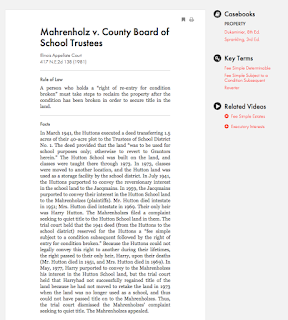
It turned out that they had all of my books except for my Contracts book (which is now being added because enough people requested it) and my Torts book (which was written by a professor at my school so it's not a common Torts book). What you do is click on which class you're taking, and there they have all of the casebooks on that subject, with case briefs (or IRACs) for each one. 

Here's an example of a brief I did in Property for class before I had Quimbee, and what they have. Theirs is a little more extensive than mine so I had to take two screenshots for y'all to see it, so sorry it looks all weird. 


all about quimbee | brazenandbrunette.com


all about quimbee | brazenandbrunette.comall about quimbee | brazenandbrunette.com 


Obviously theirs is much more detailed than mine. This is why I stopped writing case briefs after I read, because I had already highlighted in the book as I was reading it and they did a much better job than me. I know that if academic support were reading this they'd be like "doing your own briefs helps you learn," but I just didn't feel like me writing out the facts of the case instead of Quimbee was actually going to help me come test day. But to each their own.

Another thing that I liked about Quimbee is that they have videos for everything. Some are animated that explains a topic, but my personal favorites were when they had an instructor just sitting there kinda making a YouTube video to explain a concept. I would watch these videos whenever I saw them pop up by a brief and also when I was studying before finals. If you're curious what these videos are like, they have clips on YouTube for free. What I like to do is at the end of the semester I'll pull up my outline while I watch the videos and then if there's anything that is mentioned on the video but I just forgot to put in my outline, I'll be able to fill the holes in as I go.


how to use Quimbee in law school | brazenandbrunette.com


When I was studying for finals, I would take a quiz after studying for a bit to test myself. They break down each book into sections, and then have like 5-7 subsections. There's a quiz for each subsection and then a "final quiz" for each section. With the classes that spanned two semesters, it'd typically work out to where like only 3 sections or so applied to what we had learned that semester. The quizzes range from easy true/false to whole paragraphs. The paragraphs seem a little ridiculous because they're so long just for one easy question, but that actually was how my professor's questions would be on the final. Here's what a question and then explanation look like.


As you can probably tell, after I started using Quimbee I was in love. I felt like it helped make law school a tad easier, and that made it worth the price for me. I'm not going to say it helped me get the grades I did, because those grades were earned through lots o' studying, but it definitely helped me be better prepared for class. Usually what I would do is a split screen on my computer with Quimbee on one side having the case we're going over pulled up, with Evernote on the right for me to add notes, and my book out in front of me as a reference for my highlights. Sounds like a lot going on, but it really was a good system for me.

Right after finals I decided to take a leap of faith and ask this major company if they'd be willing to work with a baby blogger, and to my surprise they were super nice and excited to work with me too! So from now until September 30th, you can use the code BRAZEN and get 10% off your first month! If you're not sure you'll like it, they also have a free trial that you could use to test out, and here's a post with my suggestion on how to optimize that. 


SaveSave

May 18, 2016

The Different Types of Law School Finals Questions to Prepare For

studying for finals in law school. law school finals. law school studying. law student studying. law school exams. law school tests. law school blog. law student blogger | brazenandbrunette.com

I know that most of you reading this won't have to worry about law school finals for another 6 months, but I thought I'd write about it now while it's fresh on my mind. Maybe it'll end up helping you feel prepared when you start law school knowing what to expect at the end. Warning: this is a little lengthy but I'd rather someone feel over prepared instead of just skimping through this. 

There's been three types of questions that I've had so far on my law finals -- multiple choice, issue spotter, and deep think. Most of my tests have ended up being about 2/3 issue spotter and usually 1/3 multiple choice.


Multiple Choice

Yeah you've spent your whole life taking multiple choice tests and even had to take one to get into law school, but these are NOTHING like those! I remember my Kaplan instructor going over this "pick it and quit it" mantra when I was studying for my LSAT. You've probably been instructed your whole life that multiple choice questions are made up of 3 wrong answers and 1 right answer, so all you have to do is find the right one and move on. But for law school, you're instructed to choose the most correct answer, so your choices might be 1 completely wrong answer, 2 answers that seem very plausible, and 2 answers that are correct. Sound confusing? Here's the best way I can think to explain it.

Which of the following the best way to add and get the number ten?
A. 2 + 9
B. 1 x 10
C. 11 - 1
D. 5 + 5
E. 0 + 10

Obviously A is wrong because it doesn't even make 10.
B and C both make 10, but not through adding.
D and E both make 10 through adding, so you would have to think back on the rule.
So for this hypothetical math problem, say your professor said that the majority rule is to always add to get a number by using 0 and that number, and the minority rule is that you just add any two numbers to get that number. You'd have to not only not both rules, but also know which is the majority and minority to know which rule to apply. If you use the "pick it and quit it" rule, you would've just seen that 5 + 5 = 10, chosen the correct yet not the most correct choice, and gotten it wrong. This doesn't mean that you can think that you'll only need to know the majority, because sometimes they'll throw in a little sentence about how you should assume you're in a minority jurisdiction on some questions.

Of course, law school tests can't be that straight forward, so don't expect your questions to simply be one sentence. What they're more like is a whole paragraph or maybe two giving you a little scenario that you have to read and THEN go through all of the multiple choices. Don't think that having a multiple choice test on your final will take no time at all. For one of my finals, there were only 15 multiple choice questions but it still took me a little over an hour just because they're so thorough. For my Torts final last year, the entire thing was 100 multiple choice questions worth 100 points of my grade. This was super stressful because when I was stuck between two answer choices, I knew that if I guessed wrong I just lost a full point off my total grade in that class.

Issue Spotter

These are by far the most common type of questions that you'll have on a test. In fact, I've had a test where the whole thing was just three pages, with each page a different issue spotter. The very first time I had one on a final last year, it psyched me out. My property professor basically just gave us 5 sentences and then said, "Discuss all legal relevant factors." That was it! I wasted a whole minute panicking because I didn't even know where to start or what all to write about. I had expected some guidance after the fact pattern like "does Joe have a claim for breach of quiet enjoyment?" but I was given none of that. 

This is where your attack outline that you copy on the back of your final really comes in handy. My short outlines are broken down into a chapter per Roman numeral, and the main points of each chapter being a letter beneath that. Start with this and answer your question. Go through each chapter one by one. If a chapter is completely irrelevant, you can write a few sentences over why this doesn't apply and move on (but think of this as a little something extra that you shouldn't even bother with until you've exhausted everything that is relevant)  But if a chapter is relevant, you need to touch on every single letter you have under that Roman numeral. If you have time, aim to make a paragraph going over each point. 

But make sure that you're connecting these points to the fact pattern you were given! The easiest way to do this is through a good ol' IRAC. It doesn't have to be as in depth as the ones you do for class. It can be as simple as "The issue here is whether Joe has a claim for a breach of quiet enjoyment. The rule for QE is ... Here, X happened which is one of the requirements for QE... Because X, Y, and Z, Joe does have a claim for a breach of QE." I bolded because since that is the most helpful thing to remember. You should be throwing because's in there like it's candy at a parade. If you do this, you're going to be making yourself analyze the issue more thoroughly. The least important part is the conclusion, because you can usually argue it either way. But don't fall into the trap where you just say it depends! If you say it depends, you need to explain how/why the circumstances could end up one way, and also how/why they could the other way. 

Because you really have to master IS questions to pass, I'm adding a picture of a practice problem we went over in my Crim class. The pink are notes that I made before class about what I would discuss if this was a real test. The blue is what my professor went over in class of everything that we should've included. It's a lot of writing for not a lot of prompt! 

law school finals | brazenandbrunette.com

Deep Think

None of my professors have even mentioned this type of question except for my Crim professor, but I've had it so I might as well talk about it. These are where you don't get a fact pattern like in an issue spotter, but instead have to think about the philosophies and reasoning behind the law. He explained that he's liked these type of questions ever since he got one when he was in law school. He told us about how he got an A on his Family Law final because the last question was "Pose a question and answer it." He chose to ask whether or not gay marriage should be legalized, but didn't take the moral/religious response like you'd expect. This was way back when not a lot about AIDS was known, and really only the gay community was being affected by it. His argument was that gay marriage should be allowed simply because marriage promotes monogamy and monogamy is a great way to reduce the spread of STDs, and then went into further detail on the pros and cons for each reason to legalize gay marriage, and then the same for each reason to not legalize gay marriage. 

That's basically the structure of how these questions go. Luckily for my final, we didn't have to come up with our own questions, so we were given some guidance. My professor quoted the author of our book and asked what stance we believe the author was taking, if we agreed with it or not, and why. Don't think these are easier because it's just your opinion. What you have to do for these is discuss all of the legal theories and rules that you've learned, and apply them to your argument. Again, using your short outline as a checklist will really help give you direction of what to discuss and make sure that you don't leave out any relevant information just because you're rushed and becoming forgetful. 

Final Thoughts

Although the LSAT pretty much has nothing to do with law school, the one feeling that is very familiar when taking both tests is the sense of urgency. Three hours may seem like more than enough time to fill in a few bubbles and write a few paragraphs, but I've rarely seen anyone turn in their final with more than 10 minutes remaining. This was a change for me because I'm usually a speed demon in tests and before I was always one of the first people to finish. My advice would be that if you do somehow finish with extra time remaining, go back through your paragraphs and see if there's any little extra thing that you could add to be your sprinkles on top of the sundae and get you a little bonus points. Once you've written everything you can think of, then it's time to go ahead and turn it in.

One thing that surprised me about law finals is how informal they are. Because you almost always run out of time, law professors expect you to be writing in a rushed form. So you can use common shorthands like "bc" or "w/" and not get counted off. Same goes for terms, so you would just have to write fee simple subject to condition subsequent (FSSCS) once, and then you can use the abbreviation for the rest of the paper. I also cut down on typing time by even shortening names if I have to use them a lot by using the parenthesis after the first time I mention the name, and their initials for the rest of the time.

Also, check out my Finals Posts Round Up post for more tips to help with your finals!

May 1, 2016

What a Law School Class is Like

what law school class is like. what to expect in a law school class. typical law school class. what law school is like. how to be prepared for a law school class | brazenandbrunette.com

Today I realized that I've talked about what a typical day is like here in school, but never gave any insight to what class itself is actually like. Whoops! Major oversight on my part because it was one of the things I was most unsure and nervous about. I didn't know if it'd be as mean as Legally Blonde or as fast paced as How to Get Away With Murder, especially because of the Socratic method. I know every school is different, and every professor is different, but I have a feeling that the general idea is the same regardless.


Going Over the Case

My professors are very prompt and straight forward, so our classes generally begin with a professor diving right in to the material and calling on someone. Usually they just pick a name off the attendance sheet and then you're up. Depending on the professor, you might have to stand up when it's your turn. What the professors will want out of you is a brief background of who is suing who and why, the Issue part of your IRAC.


Socratic Method

Then you move on to the Analysis and Rule of your IRAC. You'll probably get a few leading questions asking for specific things that your professor wants you to get out of the case, like why were they suing under this theory and not another one or did the plaintiff prove all the elements they needed to. For the most part these questions aren't hard as long as you paid attention while reading and understood what was going on for the case. If there are any questions in your book after a case or within the footnotes, there's a really good chance that your professor might ask you one of those.


what class is like | brazenandbrunette.com

Open to the Class

After you've gone over the case, the professor might ask some tougher questions which you have first dibs on but could also be open to the class. These are things such as "What did you get out of this case?" or "How is this case different from the cases we read last class?" I've noticed that these seem to be more big picture questions, with professors wanting you to piece together what the chapter is about and what you should be getting out of each case.

Moving On

For my classes, we generally have about 2-3 students each class who go over the readings, with each one getting their own case or a combination of two shorter cases. In particular for my Crim class, my professor will call on two people and have one be the prosecutor and argue why the defendant in our case should go to jail and have the other person be the public defendant and argue why the person deserves a softer judgment. 

Lecture 

At least for my classes, the professors probably lecture for only 10 minutes because most of it is spent going over the rules and analysis of each case. Anything they do lecture is usually the more difficult material. Some professors put up slides with the information they want you to know, and some do a drawing or other visual so that you can understand the concepts. 

Here's what I made to print out and write my IRAC on. Mine's color-coordinated with the colors I highlight in my book as I read.


what class is like | brazenandbrunette.com
Dowload this IRAC template here


August 31, 2015

An Example of IRAC

a guide for reading and briefing law school cases | brazenandbrunette.com

I have a friend who just started at her law school, and she was posting on Facebook about being confused about briefs. Apparently her school didn't spend a full week drilling this into her brain. So just for clarity, here's a made up example that we went over in my property class:

Mitzul v. Mitzul

Supreme Court of the State of Denizen
Opinion delivered on February 1, 1979

This case comes to us on appeal from the Court of Appeals of the State of Denizen and concerns the following facts, as set forth in the record established in the court below.

Alyosha Mitzul and Ivan Mitzul are brothers who have lived next to each other, in adjacent single family homes located in Tooele County, Denizen, since 1950.  For most of this time, the brothers seemed to enjoy a good relationship, and much of their mutual goodwill appeared to revolve around their shared interest in gardening.

In particular, the brothers both participated in the caring for a large sycamore tree, which straddled the boundary line between their separate properties and which is now hundreds of years old.  The Mitzul brothers developed proprietary plant foods and treatments and nourished the tree into a towering example of excellent gardening.  This tree won many prizes and gained quite a reputation within the relatively small Denizen gardening community.  Indeed, many times over the years, third parties offered the Mitzul brothers large sums of money for an ownership interest in the tree, the buying and selling of interests in prize-winning plants apparently being a common occurrence in that same community.  For years, the brothers resisted these offers.  In December 1977, however, they received an offer they could not resist, and therein lies the genesis of the dispute at the heart of this case.

The offer, $100,000 for a 50% ownership interest in the tree, would have been easy to split in half, with each brother taking $50,000 and retaining a 25% interest, but Alyosha (hereinafter referred to as the defendant) was not amenable to this scenario.  After considering the offer, Alyosha carefully measured the tree and established that 60% of its circumference was on his property.  As such, he demanded a proportionate share of the proceeds of any sale.  Ivan (hereinafter referred to as the plaintiff) resisted.  Plaintiff contended that the precise measurements were irrelevant and that what mattered was the fact that the tree was, to any extent, partially on both brothers’ properties.  

Not being able to come to an agreement, plaintiff sued, requesting in the trial court a declaration that each brother owned half the tree and so was entitled to half the proceeds.  The trial court below found for defendant, ruling that Alyosha was entitled to full ownership of the Sycamore tree.  The Court of Appeals affirmed.  We now reverse.

There is no question that, under normal circumstances, and under well known property law principles, plaintiff would prevail.  Generally speaking, adjoining landowners equally own any vegetation that falls upon the adjoining land, regardless of the dimensions or measurements of such overlap.  See, e.g., Jesse Dukeminier et al., Property 190 (4th ed. 1969); Locke’s Two Treatises on Property Theory (Legal Classics Library, Division of Grypon Editions 1952).  

There is, however, an exception to the equal ownership rule, which exception is equally well established under the law.  This exception, colloquially known as the “Blond Giant” exception, holds that, if a controversy surrounding the ownership of vegetation on adjoining parcels arises, as in the instant case, any party that has blond hair and that stands over six feet tall will succeed to full ownership of such vegetation.  Seee.g.U.S. v. Peters, 5 Cranch 115, 136 (1809).  The reasoning for this rule runneth to a time where memory reacheth not and is so well-established that we need not repeat it here.  See id.

The trial court applied this exception to hold in favor of defendant because Alyosha is blond and stands in excess of six feet tall.  Normally, we would agree and affirm.  Here, however, the undisputed testimony below establishes that Alyosha is not a natural blond.  Uncontroverted evidence below shows that Alyosha has naturally brown hair but that he regularly dyes his hair.  The trial court, and the court of appeals in its affirming opinion, held that this distinction makes no difference and that defendant wins under the Blond Giant exception.  We disagree.

The ancient authorities are admittedly less than clear, but, to the extent they discuss the issue, they indicate that a Blond Giant exists, if at all, at birth.  Seee.g., Sir Frederick Pollock, English Law Before the Norman Conquest, Essays I, p. 104.  Indeed, no less an authority than Barbyrac states as follows, in explicating the rule: “That whensoever a blond child is born, then shall such child have preference to shared flora when he doth grow to a great stature.”  Laurence Fontaine, L’Économie Morale: Pauvréte, Créddit et Confiance Dans L’Europe Preindustrielle (1975) (citing 3 Barbyrac on Property Naturalis, § 771.45 (1583)); see also P.R.O, C.39/24, Muschamp v. Stoakes (1598) (holding the same).  Similarly, the ancient case of Muschamp, cited immediately above, indicates that “the blond emblem of birth confers the [relevant] privilege [and so invokes the exception].”  Muschamp v. Stoakes.

These authorities cumulatively indicate, then, that any claimant to the Blond Giant exception must be blond at birth.  Here, defendant was both over six feet tall and blond at the time of trial.  He was not, however, blond at birth.  As such, he was not entitled to the benefit of the Blond Giant exception.  Accordingly, we reverse the holdings below and direct the trial court below to enter an order declaring that plaintiff and defendant equally own the Sycamore tree in question.

And here is a proper IRAC


Mitzul v. Mitzul

made up citation


Deciding Court: Supreme Court of the State of Denizen

Parties: I. Mitzul (plaintiff, appellee), A. Mitzul (defendant, appellant)

Procedural History: Plaintiff sued, requesting each brother is entitled to half of the proceeds of the tree equally. Trial and appeal courts found full ownership of the tree to defendant. Trial court applied BG rule and ruled in favor of defendant even though he dyes his hair, saying it doesn’t matter.  

Facts: Someone offered to buy a tree that sits on the property line of the plaintiff and defendant's two houses. Defendant estimates 60% of the tree is on his side and suggests splitting the proceeds proportionately. Plaintiff suggests splitting it evenly because the tree is on both sides. 

Issue:  Who owns vegetation when it straddles property line? 

Rule: Blond Giant exception. If a controversy over ownership of shared vegetation, party with blond hair and over 6’ wins ownership. 

Analysis: Because defendant dyes his hair, he is unable to win under the BG rule because it states that you must be a natural blond. Since neither brother follow under the exception, judge refers back to the original rule that if there is a dispute between shared vegetation, it is shared equally. 

Holding: Judge agrees with original rule of equal sharing and not the exception for the rule because it does not apply here. Judge reverses, declaring that the plaintiff and defendant equally own the tree. 

Related: How to find the parts of an IRAC in your casebook